


In the first part, we shared how the first-class architect Mr. Hizume met the young engineer Mr. Tebasaki, how he reached out to him, and how the design plans were handed over to form the production team.
However, no matter how perfect the design plans are, if the gears of those who actually work together do not mesh, the envisioned game will not be completed. The three members of Tebasaki Games operate in a "completely full remote" setup, living in different locations, and there is an age gap of about 20 years between the director and the programmer.
In the resource-limited environment of indie game development, how were they able to smoothly create such a refined work without any communication discrepancies?
In the second part, we will unravel the "deep imagination for others" that underlies their seemingly miraculous teamwork, the enthusiasm that awaited them at the end of solitary indie development, and the "commitment" akin to obsession that each member poured into the work 'Commentator'.
※This interview was conducted on January 30, 2025. Please be aware that the content may differ from the current situation.
Tebasaki Games
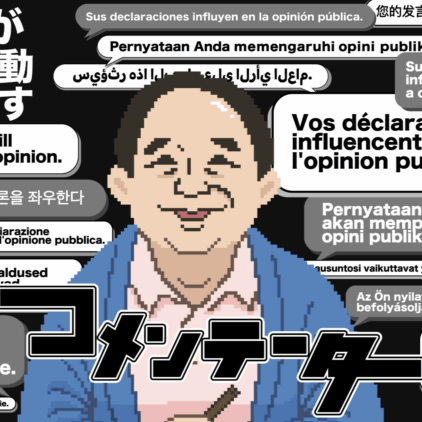
Tebasaki Games is a game production unit composed of unique members with backgrounds as a first-class architect and an AI programmer.
Game development started when Hizume, the planner and director who was envisioning 'Commentator', reached out to the programmer Mr. Tebasaki, who was still a high school student at the time. They aim to continue developing serious games that are "normally fun but provide insights."
- Hizume: Everything except programming
- Tebasaki: Programmer
- Elina: Design
Chapter 4. Full Remote Development with a 20-Year Age Gap: The Lesson of Being "Disliked" and Deep Imagination
――I would like to ask a bit more about the production. Earlier, Mr. Tebasaki mentioned that this 'Commentator' was made using Unity. What main development tools and communication tools did you all use?
Hizume: The development tool is Unity. This was because Mr. Tebasaki was starting game development for the first time, and he was only 18 at the time. I thought there were easier ways to build it, but I felt that would limit his involvement. I wanted him to gain valuable experience, so I suggested using either Unity or Unreal Engine. We discussed and decided on Unity considering the gameplay.
As for communication tools, we initially connected through Facebook, so we used Messenger for daily chats. Besides that, we use Notion, which Mr. Tebasaki set up, for records and accumulation.
――I see. When I heard about your setup, I understood that you all live in different places and were working 100% full remote. I imagine there could be some miscommunication arising from being remote, but how was it in reality? If there were none, it sounds like a great environment. I would like to know what kind of efforts you made, and from a project management perspective, what communication tools you used to check and cover tasks.
Hizume: At first, we mainly used Messenger and did some video chats as we progressed. There is a 20-year age gap between Mr. Tebasaki and me, and we only met in person for those two days, so I was always aware that I might not be particularly liked by him.
――So that was your mindset.
Hizume: Yes, I had to be careful. Being 20 years older, I felt I might be intimidating to him.
Tebasaki: Haha (laughs)
Hizume: During video chats, I tried to be a bit more friendly than usual (laughs). I also avoided making risky jokes. For instance, if Mr. Tebasaki made a mistake, I would say something like, "Don't worry about it," but I wouldn't make jokes that could only be said in a trusting relationship. I kept reminding myself, "You are not close with Mr. Tebasaki."
――It sounds like you were quite sensitive in cutting off unnecessary misunderstandings due to the distance and age gap.
Hizume: Yes, our relationship was short, and we only had those two days of the event and the after-party. It was a lot of fun, but I knew that relying too much on that fun could lead to problems, so I was very careful.
Elina: Words I want all bosses in Japan to hear (laughs)
Tebasaki: I feel like I need to learn from this, or at least be more careful myself. But really, I didn't feel much about it, yet the way they spoke was incredibly polite. There were so many things I, being younger, couldn't do, and despite that, they always offered encouraging words and maintained a bright, friendly demeanor. Even though we were fully remote, I really recognized the essence of how communication was greatly facilitated.
――The attitude of always being mindful of how to react to what I say and how it makes others feel is reflected here, not just in games. But conversely, this is something that can only happen in a small group, right? When it gets to a scale of 100 people, it becomes hard to manage.
Hizume: That's right. I believe this way of communicating only works if the other person is capable. In a large company, if someone doesn't fit in or isn't performing well, it might not work out even if you ask them to try. Fortunately, Tebasaki-kun does his job exceptionally well, beyond my expectations, and Elina is studying design in her personal life and helps out as part of that, but she’s also someone who is capable, so she responds quickly. I feel like that’s why it worked out. If things were going poorly, like if Elina's designs were terrible and the programming wasn't coming together, it might not have been a viable solution.
――But in a way, that’s already a sign of success intuitively. In other words, it’s about intuitively choosing such members.
Hizume: Yes. During the event, it wasn't just about being smart; it was also about not getting flustered in trouble. It's okay to feel anxious inside, but not to lose composure. There were some significant issues that made me wonder if we could really hold the event, but even then, they didn’t get irritated. They also didn’t have a careless attitude like, "Well, it’s not my problem." Watching that, I thought they were really capable. So I felt confident that they could handle it.
Elina: By the time I heard this story, I already wanted to hire them.
Hizume: That’s true.
Tebasaki: I’m really grateful and humbled. (laughs)
Elina: But speaking of communication, Hizume-kun is currently raising two kids. A baby was born right before the game show, which was the busiest time, so I was mindful of the timing. I thought this time would probably be busy with putting the baby to sleep, so I would throw out a rough idea with a minimum level of completion to gauge the response, and after that was somewhat settled, I would do the detailed design myself. Then I would have them do the final check.
――There’s thoughtfulness in that.
Hizume: In fact, I don’t think I’ve ever called Elina about her designs directly. Probably.
Elina: Yeah.
Hizume: I don’t think I have. We’ve been communicating through Messenger, saying things like, "How about this?" or "This would be better if it were a bit more like this." I don’t think we’ve ever had a call or meeting specifically for the design.
Elina: That’s true. We probably didn’t miss each other that much. I don’t think we’ve put out anything that we overwhelmingly disliked. I think that’s also because we’ve known each other for a long time. If it were a completely new client, I don’t think it would have gone that smoothly.
Hizume: Exactly. I think I mentioned wanting to work with someone, but that’s different from wanting to commission a contractor or freelancer. I want to work with acquaintances.
Tebasaki: In that sense, I’ve only talked to Hizume-san when we met at the event, so it’s questionable whether I can even call him an acquaintance. (laughs) We’ve only really talked when we were on the last bus together or while eating.
Hizume: I approached our communication with the reminder that Tebasaki-kun might not like me.
Tebasaki: So that’s where that came from. (laughs)
Hizume: No, no, it’s not like that. In my mind, we were already friends.
Tebasaki: Yes, yes, yes. (laughs)
Elina: I think that was the mindset.
Hizume: Right. I thought of you as a friend I could work with, not just an acquaintance.
Tebasaki: Ah, that’s really nice to hear.
――That kind of intuition definitely exists. Even if the time spent together isn’t long, you can just feel that this person will be okay.
Tebasaki: Really, in the early days when Hizume-san said, "Shall we make a game?" we had an online meeting with Elina and Hizume-san. At that time, I didn’t know Elina at all. I knew her name, but I was wondering what kind of person she was. But in just a few seconds of that meeting, I felt incredibly comfortable. It felt like there was no first-time awkwardness, almost like we were relatives. I really felt that our wavelengths matched perfectly. So that might be connected to the intuition that they are good people.
――It’s a great team.
Tebasaki: I feel fortunate.
Chapter 5. The Lonely Indie Development and the "Passion" That Breaks It
Tebasaki: Being an indie game developer is really lonely. Hizume, Elina, and I are all just so lonely. Indie games are like that. Until you release them to the market, you’re fighting in this limbo where you don’t know how users will react—whether they’ll respond positively or give you low ratings. But you have to show progress. So, the only people you can talk to are this small group, but since there are so few of us and we’re all fully remote, we can’t meet face-to-face very often. Even if indie game developers live in the same area, I think it’s still incredibly lonely. The workload for each individual in indie games definitely increases the burden on one person, so you have to carve out your own time for work, and I just remembered that the struggle with that sense of loneliness is very real.
Hizume: When we first exhibited at the Tokyo Indie Games Summit, it finally felt a bit rewarding.
Elina: That’s right~ Exactly.
Tebasaki: We received feedback that was several times more than we expected, and we got a lot of interviews lined up, connecting with various publishers. It made me feel like there was so much leverage and response. It felt like everything we had done before was wiped away, and it was like we were in the black, feeling a sense of profit. I can’t say it’s an exaggeration to say that we came to this Tokyo Game Show with all that energy we built up. Speaking of which, the comments we received from customers there, and also, Hizume must have felt it too, but we made indie game friends for the first time.
Tebasaki: We exchanged Twitter handles with people from the booth next to us, and connected with people in the venue or in different booths or buildings, asking how they make games, how they publish, what concepts they’re working with, and sharing various operational know-how. When we exchanged Twitter handles, we ended up following each other, and some long-time followers showed up. I think Hizume is the one who’s most active on Twitter, so you probably understand, but our connections really increased there. It was a huge harvest to gain those lateral connections, or teams, or comrades within the indie game community.
Elina: The people we connected with there came to the Tokyo Game Show, right? Everyone. I just remembered.
Hizume: It’s really amazing.
Elina: I forgot that someone who was exhibiting behind the scenes said we should have a drinking party.
Hizume: That’s it. That’s really big. Those lateral connections might not directly lead to something, but I feel like the sense of loneliness while creating is significantly reduced. Real-life interactions are powerful. I think even in games, real-life interactions are strong. The experience of having someone play a game right in front of you is something special. And while I do draw manga, the rich reactions I get from readers in person are something I can’t get from just having them read a book. You can see them laugh, be surprised, and enjoy it, which is very clear. On the other hand, you can also see someone deeply focused and serious about it. It’s fun. It becomes a very stimulating experience. I can somewhat understand the feelings of those who continue to develop indie games. Also, speaking of lateral connections, since the Tokyo Game Show lasts four days, by the end of those four days, the people from the neighboring booths felt like little buddies.
Elina: That’s true, no doubt about it. We took a photo together at the end.
Tebasaki: Yes, exactly. We were helping each other out quite a bit, even with people who were far away. Like when someone said they couldn’t come to their booth the next day and asked if we could leave their flyers there, we’d say, “Sure, I’ll leave them for you.” It was fun to have that kind of mutual relationship, creating a strong sense of teamwork.
――It’s almost the end, but may I ask each of you about your key points of focus in "Commentator"? I’d like to hear from each of you about what you’re particular about and what you want to be done.
Hizume: Understood. Please wait a moment (laughs).
Elina: Should Hizume go last?
Tebasaki: That’s true.
Elina: Then I’ll go first. When Hizume invited me, saying he wanted to make a game, I was really struck by that. When he suddenly started talking about wanting to make a game, he mentioned that he had a bit of a concept for "Commentator" at that time. He wanted to bring social or political topics to the forefront using the power of games, as Japanese people don’t often openly discuss those issues, and they aren’t commonly read in media or preferred. I found that very relatable because I’ve always been interested in social issues. To put it a bit dramatically, there’s a division in society that tends to swing to extremes, right? It’s not good to push those issues to extremes in Japanese society going forward; there should be answers in the gray areas too. I felt a strong resonance when I heard that he wanted to express those things.
Elina: That's interesting. I definitely want to do it. So, what came up during that time was a movie called Don't Look Up, which has a somewhat socially and politically charged story about the world being divided. As a piece of entertainment, it effectively conveys the political narrative to the masses, and she talked about how that aspect is interesting. So, personally, I think of it as social issues or politics, but it's not neutral, right? How should I put it, it's not extreme, and I really like that neutral aspect of Hizume. It feels like it says, "You can enjoy it your way," and while it might seem like it's making extreme statements about social issues or public opinion manipulation, I actually want people to enjoy that neutral aspect.
――What you mentioned was a point I really felt while playing. It's like an antithesis to just taking what someone says at face value. There's also a lesson that what commentators say could be influenced by someone else's intentions.
Elina: Oh, I'm really happy to hear that. If you felt that way, it must be incredibly rewarding for the production team.
Hizume: Yeah, that's true.
――Don't Look Up was also a movie with that kind of vibe, right?
Elina: Exactly. It's about a scientist who discovers that a meteor is coming, but there are people who don't believe him, and then there are those who believe and try to figure out how to escape that crisis. It's a movie with a lot of social commentary. But since it's a movie, it's entertainment, right? So if you go to watch it without knowing anything, people who always want to enjoy entertainment can absorb something from it. Plus, the commentators themselves are having fun, and it's simply enjoyable, right? I think that's one of the most interesting aspects of this game, where it feels socially aware but not overly serious, allowing for a light-hearted enjoyment.
――Thank you. Next person, please.
Tebasaki: I think I'll go next. Probably. I think it would be better for Hizume to talk about the interesting aspects of the game and the upcoming features, so I want to share a bit about what I focused on as a programmer for indie game developers, touching on both surface-level aspects and background details. Regarding the clear surface-level UI and UX, I think there’s a scene where you choose comments or news. You face Umesawa, and news comes up, and you have to match your hand of cards to decide which one to use. I put a lot of thought into the yellow sticky notes you place, and that was quite a challenge to create (laughs). It was pretty tough. In programming, of course, there are easy and difficult things, but creating something like that drag-and-drop feature, which is common on computers, is actually quite difficult, and I spent a lot of time and resources on that. I really love that snap feeling when you place it down.
Elina: Like a click?
Tebasaki: Yes, exactly, that clicky feeling like LEGO blocks. But it’s not a hard feeling; it has a bit of leeway, like how close you need to get for it to stick.
Elina: So there’s that.
Tebasaki: Yes, I meticulously calculated how close you need to get for it to stick and how far you need to be for it to detach. So that pleasant feeling is something the programmer worked hard to create, and I hope people can enjoy that aspect. The drag-and-drop feature may seem simple, but I put a lot of effort into it, and I also focused on the simple operation feel, text display, and animations. For example, the animation of the panels coming in from the sides, I explored how much delay to apply and what kind of animation would feel the best. There are a lot of details sprinkled throughout, so I hope people can find those little things, even in seemingly simple areas.
Now, from a programmer's perspective, I want to share some knowledge and insights about the background. I haven't had a chance to talk about the development process this time, so from a programmer's viewpoint, people who program can sometimes get too caught up in the means. It’s like the dependency can reverse; programming is just a means to create something, and you have to recognize that. Of course, making programming the goal is also very important for technological advancement and improving your skills, but when the goal is for others to play and enjoy, you shouldn't write programs just for your own satisfaction. That's something I keep in mind, and it's quite important to avoid getting caught up in the means.
For example, this time I chose Unity, but it could have been Unreal Engine as well. However, using something like BUILDER means you can't implement that drag-and-drop feature I mentioned earlier, so there are trade-offs. It's really important to use them effectively, and then there's data management. How to share knowledge. For instance, I communicate with Hizume through online calls or messages on Facebook Messenger, but it flows in a timeline format. You can forget when you said what, so I’m really interested in how to manage that data structure. I put a lot of thought into it and packed in various know-how, but the most straightforward way was using Notion to create a database for task lists, timelines, and Gantt charts. I was responsible for turning requirements into a TODO list, using methods to prevent discrepancies in understanding with Hizume. In any case, we aimed for centralized management. Initially, we used GitHub to manage repository code and issues, but issues can be confusing for non-programmers, and they don’t check issues frequently, so I made it understandable with Notion.
Recently, AI has been trending, and I've made extensive use of it. I think many of you use the VSCODE editor, but I use a cursor feature that integrates GPT into the editor, and I was developing in Unity with that. I probably use it in a way that allows me to complete tasks that usually take about 10 hours in just 1 or 2 or 3 hours, which enabled me to create large-scale processes even as a solo developer. I really felt like I was mastering AI in that sense. When it comes to making games, I also studied a lot to master AI, reading about 10 books on Unity and learning about game architecture in general, not just Unity, including single-player, OBSERVER, reactive programming, and so on. I focused on how to keep Unity's component system clean and how to avoid tight coupling by achieving loose coupling, and I was quite inventive in that regard. I also incorporated agile development into my approach. Lastly, I was particular about the fact that there were people who said they would come back tomorrow if we supported the English version at the event.
Elina: They were there! So many of them!
Tebasaki: I was at the Tokyo Game Show, probably on the first day, which was a business day, right? The next day, I had to go to Hiroshima for a hackathon called 365, which was a retreat. So, I went to Hakata Station, since I live in Fukuoka, around 6 or 7 AM, and during the 30 minutes I waited for the Shinkansen, I worked on the English support. I deployed it during the all-nighter plus that time to ensure the English version was up and running the next day. It wasn't just driven by all-nighters, but I was working through the event day, pulling all-nighters and developing, so I hope people can see that I put my life into creating this.
――There's so much information, and it's incredibly interesting.
Tebasaki: I might have crammed too much in.
――I definitely want to do a second and third installment on this topic.
Tebasaki: Let's do it.
Hizume: During the exhibition, what do you call it, field programming? (laughs) Making real-time fixes and continuously revising and improving was quite a remarkable movement. It was the same during our last TIGS event.
Tebasaki: The TIGS event was amazing. I went to the venue, and even though it was a small booth, there were two chairs behind where I could sit. I opened a gaming PC on one of those chairs and was squashing bugs and getting real-time feedback right there while everyone was playing the game. Even when I was at the capsule hotel, I stayed up all night coding and fixing things, repeating that every day to deliver a better quality product the next day.
Hizume: When you interact with customers in real-time and see their reactions, it becomes fun, and you just want to improve and fix things.
Elina: You just want to do it.
Hizume: And when they specifically choose to play the 'Commentator' at the exhibition, you want to enhance their satisfaction as much as possible with the time they spend playing.
Tebasaki: If we support English, they’ll definitely come back tomorrow. You can't just think, "I'm going to Hiroshima tomorrow, so maybe I'll skip the implementation." You have to do it.
Elina: And it wasn't just one or two people.
Tebasaki: It's incredible. Even if it were just one person, I would still go for it. That became a huge motivation for me, and I was desperately developing with the goal of delivering something great, so I hope you can feel that passion. Now, I want to pass it over to Hizume-san. (laughs)
Elina: Perfect transition. (laughs)
Chapter 6. The Unspoken Value of "Preventive Tasks" and the Future of Tebasaki Games
Hizume: Elina has already explained the essential parts of the game, so for those who will play it in the future, we are making it a game that anyone can easily enjoy. I really want people who usually don’t play political games or games themed around politics to feel free to try it out. The game itself falls into genres like visual novels, puzzles, and adventure, but during the exhibition, I realized that I could consider it a party game. It’s a game meant to be played with friends, enjoying their reactions and the fun of watching them play, so I want to delve deeper into that aspect.
So especially, if there are streamers who will commentate on it, I think they usually avoid discussing politics, which is a taboo, and they can't express their stance or even make a small joke about political dissatisfaction or insults. However, since the one speaking is the Commentator, not the streamer, they can make extreme statements or present things more seriously, and I hope they can enjoy reacting to the comments that come up freely. I feel that way about everyone who plays 'Commentator.'
Also, since Tebasaki-kun mentioned features, I want to say that we are trying to keep the game as simple as possible, even though it’s a turn-based game. I plan to add mechanisms that will surprise everyone and make them feel a little thrill. Since it’s a first game, we can’t infinitely increase the volume, so after much consideration, I decided to prioritize excitement. Therefore, in addition to what is currently available in the demo version, I will be adding more events that will thrill you, so please look forward to that.
――Thank you. Lastly, do you have any announcements?
Hizume: Well, (laughs) we are developing the game, so please wait for the release. I’m really sorry.
――I guess we can exclude X, Note, and Steam from that list.
Hizume: That's right. We'll be releasing it on X, and of course, we'll compile notes related to development, but we'll also issue press releases as needed, and we'll do our best to get media coverage so that we can communicate with everyone through various channels. I hope that guy remembers us somehow.
――Thank you. How about you, Tebasaki and Elina?
Elina: Well, every time I place a card, I think I should thank Tebak-kun from now on.
Tebasaki: Haha (laughs) One by one.
Hizume: You know, no one says it, but I think everyone feels really good while playing.
Tebasaki: I'm really happy to hear that.
Hizume: It's because it feels good. I think it's the charm of not getting caught, that no one gets stuck. That's what it is.
Tebasaki: I'm really glad to hear that. It really feels like our efforts have paid off. Speaking of which, I think I'm writing notes on how to improve UX at Tebasaki Games, but I haven't written anything about development yet. I've been writing about how Hizume-san is making this kind of game, where we exhibited, and the interviews we've had, and a bit about personal stuff, but I haven't shared anything about development yet. So, in terms of announcements, I think knowledge and know-how related to development will be coming out more and more in the future, so please follow us for that.

――I'd like to hear more about the cursor discussions, programming, and engineering, including centralized management with a small team.
Hizume: Absolutely, I think we can gain a lot from doing this.
Tebasaki: I'd like to hear about advertising from Elina. I think she's doing a great job with design-related advertising and approaches that aren't just about behavior. It feels like Hizume-san is managing and designing the concept, I'm doing the development, and Elina is successfully bringing it all together, so I really want to see everyone's knowledge and know-how shared.
Elina: Well, I don't think I'm doing anything that amazing (laughs).
Tebasaki: No, no, you're already doing it.
Elina: Sure, there are things I've stumbled upon. Sometimes Hizume says, "This is good," but it can be really troublesome, you know? We could create a space to vent about those things (laughs).
Hizume: That's true.
Tebasaki: I have no idea, so I want to hear about it.
Elina: But those kinds of things are interesting. Behind-the-scenes stories about development. Hizume, you say that, but do you know how much troublesome processing is needed behind the scenes? I'd like to hear about that; it sounds interesting.
Tebasaki: That took a different direction (laughs).
Elina: Actually, normally, even with the card discussions, you wouldn't think that so much effort goes into those seemingly trivial places, but there are all sorts of difficult aspects in graphics. But actually, because certain processing is needed on the backend, there are times when you have to fix things in a piecemeal way, right, Tebak-kun?
Tebasaki: Yes, that happens.
Elina: If I could hear about those things, even though I have no programming knowledge, it would help me understand the literacy of the ordering side, like when I or Hizume place orders, so I'd like to hear about that.
Tebasaki: Indeed, it's not just about talking about what went well or the essence; it's also about sharing the failures and struggles we've faced. Those stories are often hidden or not talked about.
Elina: Right, because they aren't sparkly, not much.
Tebasaki: Everyone is making things look sparkly, so discussing those things is really valuable for indie game companies. It gives a sense of reassurance and a roadmap to know that these people have had similar experiences and failures. I think that's really valuable.
――The most unspoken but most important point is "things that could have been prevented." Because they could be prevented, there are no fires and no struggles. But there are definitely tasks to prevent them, right?
Elina: That's true, it's about making sure that doesn't happen.
Tebasaki: Ah, I hadn't thought of that. I want to talk about it and hear about it.
Elina: But to talk about that, we need to realize what we were preventing, right?
Tebasaki: That's right. We need to be aware of it. We have to have a meta-awareness. If we want to bring it up ourselves, it probably won't come out. Probably. When someone asks, "What did you do here?" and we say, "Oh, we did this," then it clicks. I feel like we probably can't notice it ourselves.
――So that might be something we can't ask about until the third installment, once we know more about you all.
Tebasaki: I think that's really valuable. I don't think there's anywhere else digging this deep in indie games.
――If we can dig this deep, it might be a first. I might have gone a bit egoistic with this discussion.
Tebasaki: No, but I hadn't realized it. I think I've seen things that indie game developers often overlook.
――Thank you very much. Well, it ended up being a really long time today, but I truly appreciated being able to hear a variety of things from multiple perspectives, as well as the charm of the game and the unique personalities of the team members who created it. I think I gathered a lot of hints about team building and how to create a team. Alright, I would like to wrap things up now. Today, we had with us the members from Tebasaki Games, who are producing 'Commentator': Mr. Tebasaki, Ms. Hizume, and Ms. Elina. Thank you very much for today.
Tebasaki: Thank you very much.
Elina: Thank you~.
Hizume: Thank you very much.