

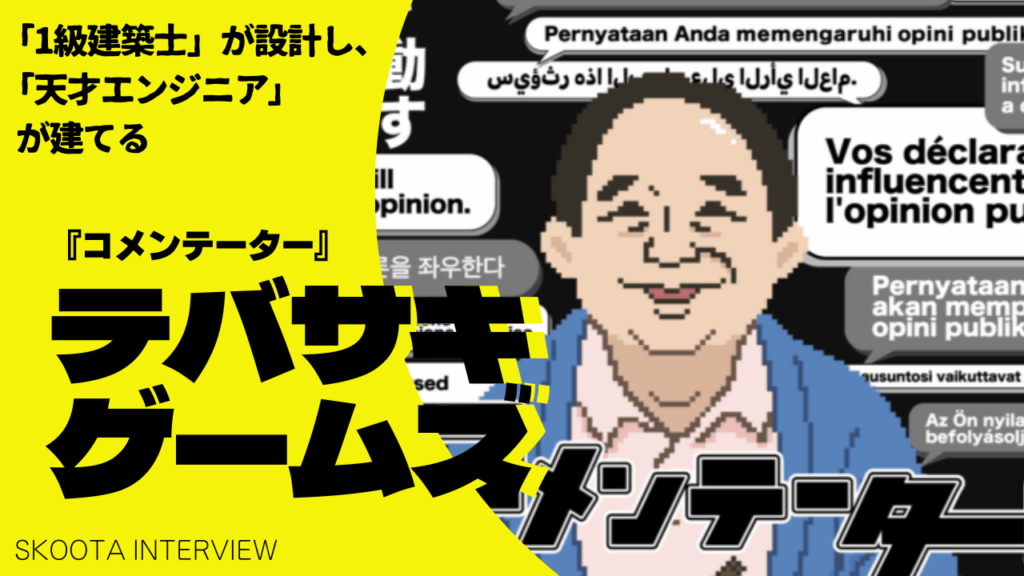
Indie game development is sometimes said to be a product of "momentum" and "passion." However, here we have a team that builds games with an almost bizarre level of "precision."
Mr. Hizume, a first-class architect and manga artist, and Mr. Te basaki, who met him during high school and is now working as a full-stack engineer. They are joined by Ms. Elina, who works in public relations for a medical institution, forming Te basaki Games.
Why is their debut work, Commentator, so "easy to play and straightforward"? Behind it lies the logic of an architect who has even experienced being a project manager for a nuclear power plant, along with an astonishingly perfect "blueprint" for implementation.
This time, we asked the three individuals from completely different backgrounds how they shared a single vision and arrived at the "correct answer" as a team. They spoke candidly about their meeting and the starting point of development.
*This interview was conducted on January 30, 2025. Please note that the content may differ from the current situation.

Te basaki Games
Te basaki Games is a game development unit composed of unique members with backgrounds as a first-class architect and an AI programmer.
The game development started when Hizume, the planner and director who was sketching the concept for Commentator, reached out to Te basaki, who was a high school student at the time. They aim to continue developing serious games that are "normally fun but also provide insights."
- Hizume: Everything except programming
- Te basaki: Programmer
- Elina: Design
Chapter 1. Provocation of the Key Visual: "Isn't this guy a commentator?"
-- Thank you for joining us. Today, we have three members from Te basaki Games with us, and I would like to start by asking each of you to introduce yourselves briefly. Let's start with Te basaki.
Te basaki: I'm Te basaki. I am responsible for programming in Commentator, and I usually work as a full-stack engineer, doing things like AI programming. Nice to meet you.
Hizume: Yes, I'm Hizume, and I handle everything except programming at Te basaki Games. Nice to meet you. I usually work as an architect and also engage in manga creation. Thank you.
Elina: Hi! I'm Elina, responsible for advertising and design at Te basaki Games. I usually work in public relations for a medical institution. Nice to meet you.
-- The game you are currently developing, Commentator, has a very unique concept and I think it’s a work with a very sharp focus. Could you briefly explain this game and share what inspired you and how the development started?
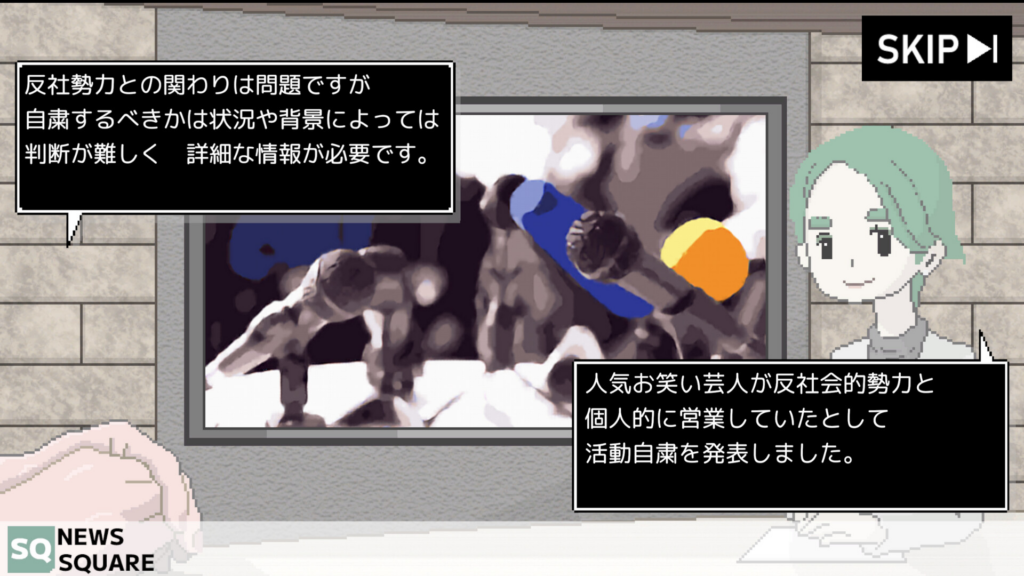
Hizume: To start with the concept, the player, who is the protagonist, becomes a commentator in the game world, appears on a news program, and comments on the news. During meetings, players select comments for various news stories like a puzzle, which then changes their statements during the live broadcast. These statements affect viewer engagement and sponsor satisfaction, and the game allows players to experience how their scores can change the world.
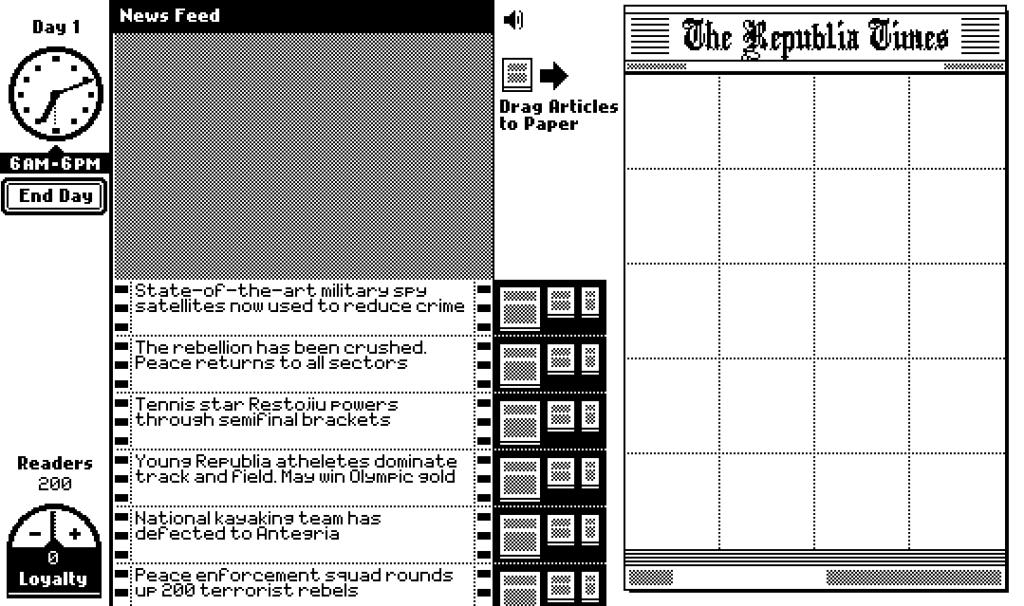
Hizume: The inspiration for this game didn't come from me; there is already a free game called The Republia Times in the world. It was created by Lucas Pope, the developer of Papers, Please, where the protagonist is a newspaper reporter. The game allows players to enjoy how the world changes based on what news is covered and how prominently it is displayed. When I first played it, I was incredibly shocked. It’s a very interesting game, but it’s set in the 1950s or 60s, and the location is probably a small military state in Eastern Europe or something like that. For Japanese people, it’s a bit distant both geographically and historically, and while it’s a very interesting game, I thought it would be more enjoyable if it were set in a more familiar context. Since there weren’t any other games like that, I thought it would be fun to create one.
――Indeed, living in Japan, I feel like there are so many opportunities to encounter news programs on TV throughout the morning, afternoon, and night, so the theme selection in that regard felt very familiar. It was very impressive, and I thought the points of inspiration were great.
Hizume: Thank you. Yes, since we wanted to keep it as close to home as possible, newspapers still exist, but when it comes to articles on the internet or other forms that influence the world, I thought about what medium players would find familiar and not question too much. As you mentioned earlier, TV news that flows somewhere all day long still seems to be the most familiar. Additionally, instead of anchors, we have commentators, which are quite common in Japan but not so familiar overseas. By adding that and making it the protagonist, I feel like we created a strong sense of locality.
――Indeed, as you just mentioned, the commentator role is quite unique to Japan. Overseas, the focus is on the "anchor" position, but in Japanese programs, there is a host and several commentators who listen and discuss from different perspectives. When you think about it, the commentator position is interesting.
Hizume: That's right. So, it doesn't necessarily have to be someone with expertise; for example, even a talent can represent what the viewers feel, empathize with them, or provide a unique perspective. I think that's a unique point of the commentator profession. So, when dealing with that mixed bag of news, players will inevitably come across news that they think, "I don't really understand this," which I believe reflects the feelings that Japanese commentators encounter. I thought it would provide a nice pseudo-experience.
――I also played the demo available online, and there are definitely some points that people are curious about regarding this game, which I wanted to ask you about today. The old man in the key visual is not a commentator but a producer, right? (laughs)
Hizume: That's right. He is a producer of a TV program. In the original game 'The Republia Times', there is no depiction of the protagonist at all. The news appears only as a punch list of articles, and I found it interesting that there is no depiction of the protagonist. This time, the protagonist is the player, so I wanted a protagonist that doesn't have much color, ideally depicted entirely from a first-person perspective, which led to the decision to have a protagonist without a visible form. After that, we thought we needed a producer and a girl as a caster. The reason for the girl is that the producer is an old man, so we needed to balance it out. To maintain the visual balance of the game, we included a girl because otherwise, it would lack vibrancy. That's how it was decided.
Hizume: So, when we thought about the key visual, we could only have either a girl or an old man, and since we are a fledgling indie game development unit, we needed to stand out to get attention. Among the character designs we had, when we first created the illustration of the producer, Umezawa, the reactions from our members, Tebasaki and Erina, were incredibly positive. They said, "There's no one like this, right? It's interesting," so we decided to go all in with this old man. After that, we joked about it ourselves, saying, "Isn't it fine?" (laughs). You can understand once you play the game.

Erina: From a designer's perspective, the impact of this old man is so strong that it can catch attention by itself. In the gaming industry, there are often very cute girls or flashy characters in key visuals, but here we have a visually plain old man making a bold appearance, and that visual does a great job.
Hizume: I don't think there is a single old man wearing a cardigan and polo shirt in key visuals.
Everyone: (laughs)
――What about you, Tebasaki-san?
Tebasaki: I'm sorry. From a game-loving programmer's perspective, or rather, not even that, but as someone who loves games, I thought it was really reminiscent of 'The Legend of Zelda' that the old man looks like the main visual. You think the protagonist of 'The Legend of Zelda' is that boy, right? "That kid is Zelda," you think. But it's completely different.
Elina: It's different!?
Tebasaki: It is. (laughs)
Elina: Seriously?
Tebasaki: That's how it is.
Hizume: The boy is Link, right?
Tebasaki: Yes, it's Link-kun.
――In that sense, this key visual has a surprising depth that reflects the game's context. As everyone has mentioned, this key visual is very eye-catching and doesn't get lost compared to other games. In fact, it draws a lot of attention to this subtly eerie character.
Tebasaki: It does have a slightly suspicious vibe, doesn't it?
Elina: Hizume said something really interesting when he was drawing it, that he aimed for that delicate line of not knowing if the character is a good person or a bad person.
Hizume: He did say that.
Chapter 2. The Fate of the Bus Stop: "Hitting on" a First-Class Architect and a High School Engineer
――I don't know if this connects to the key visual discussion, but I have a question for the three of you regarding this work 'Commentator'. What elements were focused on or created to embody this game?
Hizume: Since I'm the one who initiated the game itself, I actually want to hear from Tebasaki-kun about this. I'm curious, rather.
Tebasaki: Well then, I’d like to ask Elina-san a bit.
Elina: Huh!? (laughs) I actually want to ask the opposite, why did you decide to go along with Hizume's invitation, Tebasaki-kun?
Tebasaki: Well, if that's the case, should I start from the very first episode, the meeting episode?
――Yes, I’d love to hear that.
Tebasaki: I can't remember if it was around this time last year, but there was an event where I think there was a workshop for a game called 'MINECRAFT'. Hizume-san created a world in 'MINECRAFT' to build buildings around Saga Arena and had kids play in that workshop event. I was also acquainted with the organizers and participated as staff. We did a workshop together, and then went out for drinks afterward. That's when Hizume-san mentioned wanting to make a game. Since I'm a programmer, I said I could make anything, and then it turned into, "Well, let's try making a game together," and that's how we got here.
Tebasaki: At that time, I didn't know what kind of game we would make, but as we communicated later on Facebook, I found the ideas to be really fresh and unlike anything I had done before. I was really excited. You often see things like, "Isn't this from another game?" or "This is almost the same as that," but this was completely different in direction and seemed really interesting, so I just dove into the development from there.
Hizume: By the way, to be precise, we got excited not at the place where we went for drinks, but at the bus stop on the way there.
Elina: Oh, really? (laughs) I knew that Hizume originally wanted to make a game, and I had heard some ideas at that time. So when I met Tebasaki-kun, I was told in a way like, "I found this kid who seems like he could do a great program at the last event, I hit on him!"
Tebasaki: I didn't know that. (laughs)
Elina: I thought, is there really a high school student like that?
Tebasaki: I was indeed a high school student at that time.
Elina: So that was the vibe.
Hizume: Yeah. At that time, Tebasaki-kun was a high school student, and he participated in the event as a supporter for the operation. We held a full-day event over two days, and amidst various troubles, there was one kid whose movements were different; he resolved things very smoothly and didn't panic. Plus, he quickly reported the situation to those around him. He was a capable kid, and I thought, "There's something amazing mixed in here; is he a university student volunteer or part-time worker?" Then, after talking for two days, somehow we ended up discussing ages, and I found out he was a high school student. I thought, if a high school student can do this much, it might be interesting to work together. Then we talked about the game.
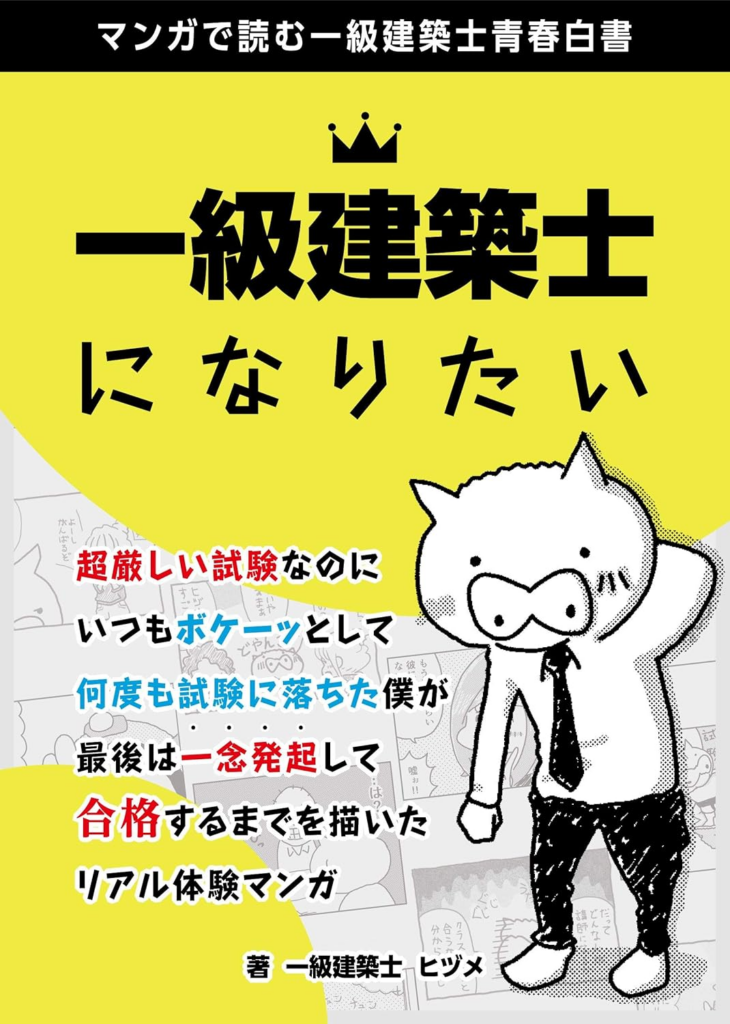
Tebasaki: So, originally, while we were introducing ourselves, I was surprised to hear that Hizume-san is a first-class architect. Conversely, when I introduced myself as a programmer, Hizume-san started talking about wanting certain apps, not just games. When I responded with something like, "It would be nice to have a smartphone app like that," the conversation shifted to, "What kind of things can you create, Tebasaki-kun?" Even though I said I was a programmer, there are various types, right? Writing AI programs, creating websites, making games, and so on. I consider myself a full-stack engineer, which means I can pretty much do anything.
Elina: A good guy, from back-end to front-end.
Tebasaki: Exactly, that's right. So, I made a slightly risky statement saying, "I can pretty much create anything" (laughs).
Hizume: You did say, "I can pretty much create anything."
Elina: And you're tightening your own noose with that, aren't you? In various ways.
Tebasaki: Hahaha (laughs). Yes, I thought it wasn't good, but when I talked about being able to create anything, it led to the conversation about, "Well, I have a game I want to make."
Elina: Hizume really picked up a good talent...
Hizume: Right? So, the essence of "Commentator" is about encounters, I guess. It's a game born from encounters.
――The important element in creating "Commentator" is indeed the initial encounter.
Hizume: That's right. I never intended to create the game alone from the start. There are ways to create it, and you can look it up online, and now with AI, it's possible to create something alone in some form. But I enjoy working with people, so when trying to do something I've never done before, I want to earn some revenue by collaborating with someone else. So, I really think the starting point of "Commentator" was indeed the encounter. I thought that with Tebasaki-kun, we might be able to create something interesting.
Chapter 3. "Architect Specification": Building a Game with Power Plant Blueprints
――Tebasaki-san, who was a high school student handling events smoothly, what was your motivation for wanting to participate in this game from the beginning?
Tebasaki: Well, there are many reasons. Recently, I've been involved in various clients and development work. I create programs and apps individually, but I’m not the type who finds it enjoyable to do the same thing as others; I want to create something unique. I’m the type who wants to create something with creativity.
Tebasaki: So, my motivation is quite rooted there. When I heard about this opportunity, if it was just following a trend or something like, "Let's imitate what's popular," I probably wouldn't have been interested. But when I was approached about "Commentator," it resonated with me deeply. I really wanted to see how players would react when this game hit the market, the feedback, and the growth. I could clearly envision the quantitative download numbers and high ratings. I could vividly see streamers having a blast and players discussing online about which is better, and that made me want to create it, play it, and have others play it too. That was my motivation.
――You want to create something unique while being conscious of the "numbers" that are appreciated by more people. How do you balance that trade-off?
Tebasaki: I love creative things, and I create apps individually, so I constantly think about these things. But it’s a battle with trade-offs. Basically, it’s not just one trade-off; there are multiple layers, creating a complex trade-off in the creative industry. Regarding "Commentator," to be honest, I have a specific group of people in mind that I hope will resonate with it. Of course, that can be measured quantitatively, but I’m not talking about tens of millions or hundreds of millions of people. Even if it’s just 10,000 core fans who are really into it, that data alone makes me very happy.
Tebasaki: So, in terms of selling a lot, there’s a significant trade-off, but I’m more interested in how deeply people get into it and how much they love it. I was moving with the thought that even a small number of people getting into it would be great. The market is determined, and the pie is set. However, with "Commentator," I was unsure how it would turn out, and I wanted to see that future. I thought it would resonate with a very core fan base, but when we showcased it at the Tokyo Game Show (2024), I felt that it resonated with not just core fans but also announcers and various age groups of fans. I was really excited about where this could go.
――As a full-stack engineer, what technical aspects do you particularly focus on?
Tebasaki: Well, since I’m full-stack, I deal with front-end, UI, UX, and back-end database management. In terms of games, it’s about how to manage and design data. The most important thing is to ensure that I don’t confuse purpose and means. When I went to TIGS or the Tokyo Indie Game Show, I saw many indie game developers for the first time. I noticed that there are many people with high technical skills. While they are indeed skilled, I found that some of them had a disconnect between purpose and means.
Tebasaki: My goal is to have many people play and enjoy the game. So, I realized that I shouldn’t write programs that only satisfy my own self-indulgence. Even if I write a complex program behind the scenes, optimize it, and write beautiful code, if the game looks terrible and has a bad UX, players probably won’t enjoy it. The purpose is to provide value, and the means can be any programming language or engine. This time, we used UNITY, but it could have been UNREAL ENGINE or even building an engine from scratch. As a programmer, I focused on not getting too caught up in the means and worked hard on development. I aimed to keep it as simple and intuitive as possible, minimizing the number of buttons and actions. I was very particular about providing clear controls and enjoyable feedback.
――It was very easy to play when I actually tried it, but what points or perspectives did you focus on during production?
Hizume: That’s the same as what Tebasaki-kun just said. I wanted to ensure that players would genuinely enjoy it. I wanted to determine what would be fun about this game and make sure that players could enjoy that aspect. So, while I work in a planner role, I also want to minimize any strange noise that might interfere with what we think is interesting. For example, I want the game to be playable without a tutorial, and since it’s not a game with a lot of tasks or parameters, I aimed to make it as approachable as possible, so even first-timers can play it. At the same time, I wanted to ensure that what we find interesting about the game is clearly communicated.
――Elina, what points do you observe in the movements of Hizume and Tebasaki?
Elina: Well, Hizume is a first-class architect, right? So, he gives instructions to Tebasaki like, "We're going to design it this way," and he has requests for me saying, "I want to create something with this kind of image." It's very architecturally detailed.
――Architectural details, that's interesting.
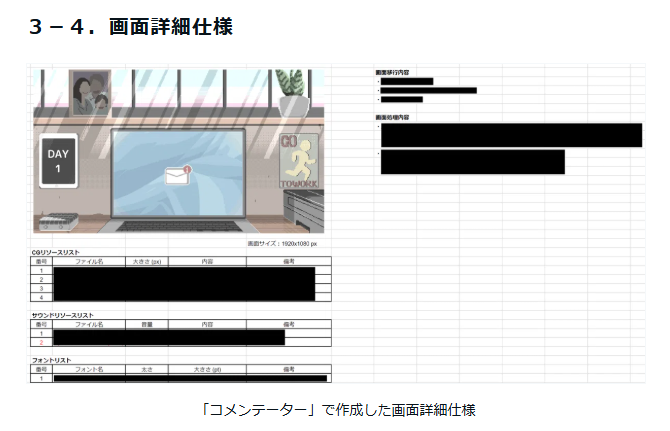
Elina: Yes, it's really organized, like a spreadsheet, and the requests are very clear about the specifications for each part. You can really see the work ethic of the architecture industry in that, and for me, it was very easy to understand. Since I've known Hizume for a long time, I have a sense of what he likes, like what kind of backgrounds or fonts he might not prefer. So, there's this unspoken understanding between old friends, which made it really easy to work together. But I wasn't really involved in the exchanges between Hizume and Tebasaki, so I’d love to hear what Tebasaki thought about that (laughs).
Tebasaki: I totally agree with Elina on that architectural specification thing; it's really great. It's like I finally found the words to express it.
Hizume: Is that so? (laughs)
Elina: It's a bit different from requirement definitions; it's not exactly a process chart. Before I worked in a medical institution, I was at a production equipment company, so while it's not as detailed as architecture, I worked on equipment within factories. So, I often created process charts, and Hizume's specifications were very close to that, clearly outlining the steps and how the goal looks. That was really good, right, Tebasaki?
Tebasaki: Yeah, it was really good.
Elina: So, as a team, Hizume's clear instructions and the visualization of the goals were really beneficial, and I think that was great.
Tebasaki: I completely agree with Elina. Hizume, in my side projects, when I develop various systems or apps, I often start with requirement definitions or receive them to implement. But what's amazing about Hizume is the level of detail in the specifications he creates for things that aren't even done yet. It's like a tutorial guide that explains a game that's not even running yet. There were many moments where I thought, "How can you see that?" Even someone new would definitely understand it. From the pixel size of the font to how I want to place things, how the animations should run, and what files to use are all enumerated. It felt like looking at a blueprint of something already built, and I was really moved while working on it.
――I hope you can share that within a public range on platforms like note. You could write a book on your know-how (laughs).
Tebasaki: I haven't done that, come to think of it. Hizume. I think it would sell. You could write a book on your know-how. (laughs) It feels like it could sell as a framework for indie game developers. Honestly, I want to know how to write it, so I would buy it (laughs).
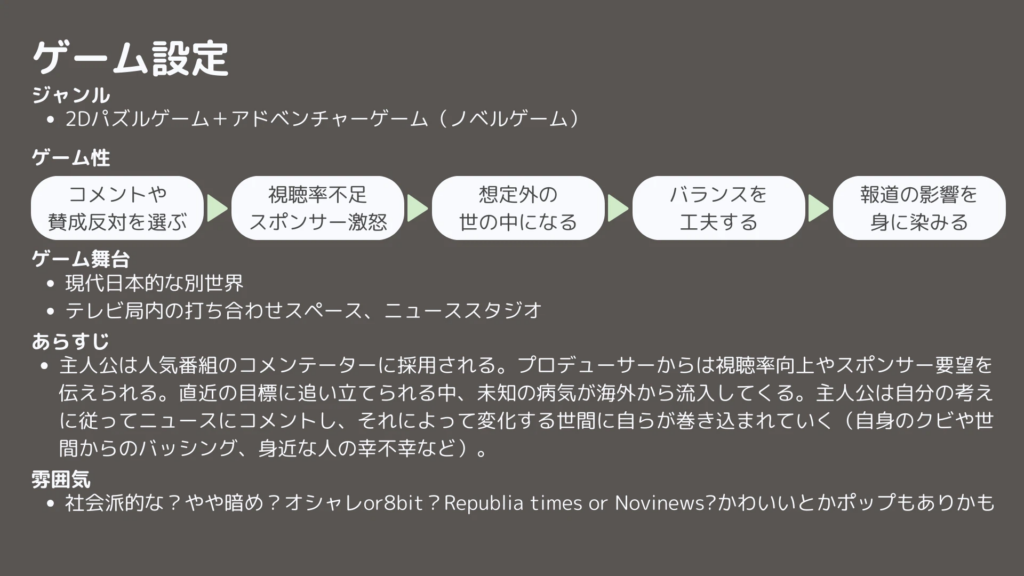
(Game settings).
Hizume: Well, you know, when it comes to game development, I should be buying books and using them as references while creating the game. Of course, they don't go into that much detail, but I've bought books like "Introduction to Game Planning" and read them. Also, I've read things like the "Indie Game Survival Guide," and thought, "Ah, so this is how it is." It's not exactly simple samples, but there are things written that give me an idea of how to convey this kind of feeling. And in terms of work, while I am indeed a first-class architect, what I do isn't about buildings in the world; it's about designing power plants. It's the design of power plants and substations.
Now, when people think of project management, or "pro-manage," many tend to imagine the IT industry, and I think there are probably more people in that field. However, in the plant industry that builds substations and power plants, there are also project managers, referred to as pro-manage, who oversee engineers creating those structures. I feel that my experience on that side is being utilized in my current job. So, I have read at least the PMBOK for project management.
Harada: Listening to you, I really get the sense that you have a lot of imagination for the recipient, like you can anticipate what would be better for this particular person.
Hizume: Yes, I appreciate that. That's right. When I was working as a project manager, there were many highly educated and intelligent people, so writing in a way that appeals to them was preferred. Then, when I actually went out to the field to work, especially in plant construction, there are many subcontractors, even sixth-tier subcontractors, and I had to teach things to elderly men with no teeth who only graduated from middle school, explaining how to do things. Showing them something written for project managers wouldn't communicate anything to them.
I also tried to include as many illustrations in the specifications as possible. Later, when I was unemployed and working at a friend's public bath, I was creating manuals, but even then, while sixth-tier subcontractors were used to reading, it was a huge hurdle for young men around twenty to read text, and they would wonder why they had to read such things. So, I thought about making manuals in Instagram videos instead. I guess I really want to convey things as much as possible.
Harada: The imagination that programmers might want this kind of information is impressive. It seems like it's hard to pay attention to that.
Tebasaki: It was amazing. Really. It was written in a way that was easy for programmers to understand. That notebook was all written by Hizume-san, right? I think almost everything was written by Hizume-san, and that ability to convey information is outstanding. We have regular meetings, and even as a programmer, he talks in a way that I can understand, and he really picks up on things, which made the development cycle run very smoothly.
Hizume: I'm glad to hear that.
(To be continued in Part 2)