

This article can be listened to as a podcast on the following media.
Guest and Personality
Guest: Miku Mizue
Animation creator
Born in 1981 in Fukuoka Prefecture. An animation creator who produces non-narrative expressions inspired by "cells" and "geometric shapes." Known for her unique abstract animations that captivate viewers, she works extensively in independent animation and music videos.
She has been nominated at all four major animation film festivals (Annecy, Ottawa, Hiroshima, Zagreb), and her representative work 'MODERN No.2' had its world premiere at the Venice International Film Festival and won the music award at the Annecy International Animation Film Festival.
'WONDER' had its world premiere at the Berlin International Film Festival and won the CANAL+ Creative Aid Award at the Annecy International Animation Film Festival. She is currently preparing for her first feature-length animation 'Mizue's Journey (tentative)'.
Personality: Yuki Sakoda
After working at a telecommunications company and a general advertising agency, he founded an anime planning and production company, producing visuals for music videos and films. In 2021, he moved to Kyoto and began working to promote the entertainment industry there. Recently, he has also been involved in the manga and audio entertainment fields, currently planning and producing audio dramas and webtoons. Additionally, he serves as a producer and advisor for multiple entertainment companies.
Overall Table of Contents
#01
・What is non-narrative expression in animation?
・His work was screened in the non-narrative section at a film festival
・Interpretation of works that do not have a "story" but do not place "story" as the pillar of the work
・Continuing to create what he loves without worrying about genres
・Falling hurts, but soft things feel good
・From Jurassic Park and Terminator to the Lumière brothers
・Movies are not just about stories; they also provide moments of experience
・Loves unforgettable experiences scattered throughout films
・A summer day, directing a monster movie play mimicking a chemical plant in a vinyl pool
・Memories of watching Return of the Jedi in theaters
・Growing up with parents who love movies
・Waiting in line to see The Phantom Menace in his senior year of high school
・Longing for the analog experience of theater spaces
・The shock of seeing T-1000
・Wanting to see the unusual and the strange
・From an interview about ETERNITY
・Creating experimental and strange things within a short duration
・A ride-type experience to create something non-narrative that keeps you awake for 20 minutes
・Realizing you were in the theater when the movie ended
・A night of biking wildly after watching E.T.
#02
・Watching subjective images on a large flat screen becomes VR
・The pleasure of visuals in "Spider-Verse"
・The value of non-verbal communication
・Ambiguity when communicating with words
・Words from a woman who saw "WONDER" in Germany
・Non-verbal communication may have the power to make viewers think spontaneously
・Not good at surveys
・Talking about "Fraggle Rock"
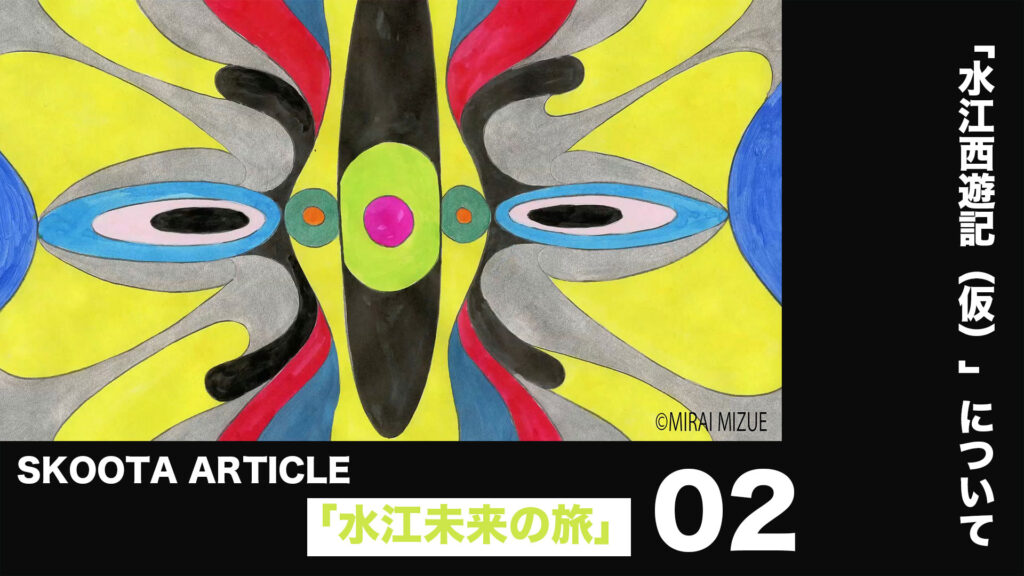
・About "Mizue's Journey (tentative)"
・What it means to do Journey to the West now
・How humans live and how they perceive the world
#03
・About "License of Love"
・Introducing many characters
・The theme of expanding life and death
・From a science book by Gakken read in childhood
・About the song by Twoth
・Also created a song for Into Animation 8
・About the program for Into Animation 8
・Animation is becoming a more interesting era
・Animation is starting to cross over, chaotic but stimulating
#02 Begins
Watching subjective images on a large flat screen becomes VR
Sakoda
Just a light recap, I first asked Mizue-san to interpret the term "non-narrative," and she shared various thoughts. From there, as we discussed stories, I learned about Mizue-san's foundational experiences, and it was clear that her parents loved movies from a young age, taking her to see many films, including discussions about 'Jurassic Park' and 'Terminator.' One expression used in those films, CGI, seemed strange and unusual to Mizue-san, yet it left a strong impression that it leads to pleasure, which I think connects to what is being created now.
In that context, regarding 'ETERNITY,' I would like to hear about the liberation of the spirit from the body and the potential of abstract animation, as well as its non-verbal value. I feel that flat content presented in a first-person perspective in a theater on a large screen is no different from VR, and perhaps it is a more stress-free way to experience VR than forcibly wearing a head-mounted display.
I have always thought that showing a ride-type experience on a giant screen might be the most stress-free and enjoyable way. I really like Shugo Tokumaru, and I think it would be so pleasant to listen to his music at high volume in that setting, although I couldn't attend. That's something I've been thinking about.
Continuing from that, I would like to discuss the potential of abstract animation and the value of non-verbal communication. What do you think?
Mizue Miku
Yes, there was a discussion within the team about creating a VR version of 'ETERNITY.' We even applied for a grant for the production of the VR version, but unfortunately, we were not able to receive it. Therefore, after finishing the production of 'ETERNITY,' we couldn't start on the VR production, but indeed, moving in a first-person perspective while watching a large screen can provide a VR-like experience.
For example, the attraction "Back to the Future" that used to be at USJ had a DeLorean inside a hemispherical screen, and even if you turned your head, everything was still within the screen, right? If you really tried hard, you could see the edges, but basically, your entire field of vision was covered. That felt like real analog VR. When I first experienced VR, I thought it was like "Back to the Future: The Ride," and I definitely had a desire to create something like that.
Recently, yes, "Spider-Verse" is a movie that does that kind of thing. It's really a flood of visuals, and the pleasure it brings is immense. "Across the Spider-Verse" starts with a homage to Oscar Fischinger's experimental animation. The scene where they are drumming is like, "Wow, really?" For someone who creates that kind of animation, it's surprising to see Oscar Fischinger referenced.
Then, there's a scene where a massive number of Spider-Men are chasing after someone, which reminds me of a director from France named Paul Grimault, who originally made a feature animation titled "The King and the Mockingbird." In that film, a man and a woman are on the run, and there’s a famous scene where they are chased by a large crowd while running down a grand staircase. It evokes that feeling. The creators might not have referenced it at all, or it might not even be on their minds, but I think there are other scenes where a large number of people chase someone, so it’s not entirely unique.
But still, there’s this feeling of being impressed that people who have been familiar with independent animation or European feature animation are incorporating such expressions. At the same time, it’s incredibly exciting, so movies like "Spider-Verse" give a sense of expectation that various people can create their own versions of it. It makes me feel like I should also work hard on my own feature film. There’s definitely a lot of visual pleasure in recent works.
Sakuda
Since the phrase "let's work hard on a feature" came from Mizue, I feel like we could talk about the feature film you’re currently challenging yourself with, or we could stay on the topic of "The King and the Mockingbird" and perhaps link it to Hayao Miyazaki given the current context, which also sounds interesting. I have a lot of thoughts on various things.
Also, regarding the metamorphosis animation and what is done in "ETERNITY," there was a mention of mandala motifs, and I think it’s fundamentally very Buddhist in its thinking. It’s like "Form is emptiness, emptiness is form," or "All things are impermanent." So, I’d like to hear more about those motifs and such. I feel like I have a backlog of questions for Mizue (laughs). But for now, I’d like to ask about "ETERNITY" and what you think about the value of non-verbal communication.
Mizue Mirai
Well, language is very difficult, right? Without a common language, communication can’t happen. Even among people who speak the same language, like Japanese, if there’s a significant generational gap, it can lead to misunderstandings like, "What did you just say?" I teach at a university, so I talk to students who are about half my age. For example, students use the word "昔" (mukashi, meaning "the past") and say things like, "I’m going to depict something from the past." When I ask, "When is that past?" they say, "When I was in middle school." Essentially, that’s like five years ago for them. But for me, five years ago isn’t really the past.
So, when referring to the past, present, or future, it completely depends on the person’s age, how much life they’ve lived, and what experiences they’ve had. The meanings of "past," "present," and "future" can differ greatly, so even if we use the same language, if we don’t discuss it thoroughly, we often find that we’re not actually communicating. Therefore, when communicating, I think it’s important to listen carefully from various angles, and it’s not just about one conversation; it’s through multiple discussions that we gradually understand who the other person is. In that context, non-verbal films or my animations are liberated from the constraints of language.
Mizue Mirai
I went to the Berlin Film Festival about ten years ago. At that time, I screened a work called "WONDER," which is an animation that continuously morphs colors and shapes for six minutes. PASCALS created the music for it, which is very uplifting. After the screening, a woman from Berlin came to give me her thoughts.
In the past, when people commented on my works, they would say things like the music and visuals were well-timed and felt good, or that there was a lot of movement and it was exciting—essentially, they were responding to the visual stimuli. But for "WONDER," I received a different kind of feedback from that woman. She said, "I’ve been wearing black and gray clothes to work every day, but starting tomorrow, I think I’ll wear red, yellow, or blue clothes and try to bring some WONDER into my life." She left after saying that.
I hadn’t said anything like that in the film. She interpreted it that way on her own. I thought that was amazing—that my work, which is an abstract, non-narrative animation, could inspire someone to think, "I’ll do this starting tomorrow." It was the first time I witnessed the power that animation can hold.
Even though I had been making animation for over ten years, I never expected something like that to happen with my work. I really felt the power of animation at that moment, and since then, my purpose in creating has become much clearer. Essentially, through the experience of watching the visuals, I hope that people can come up with new ideas or incorporate something different from their previous selves. I don’t necessarily want to change their thoughts, but I expect that such things can happen, and that’s how I’ve changed my approach to creating works. In that sense, non-verbal elements can evoke something from within a person, prompting them to think.
The Value of Non-Verbal Communication
Sakuda
Ah, considering the episode from the Berlin International Film Festival, I think the value of non-verbal communication was conveyed very clearly. People tend to think that because we use words, they are the easiest way to understand each other, but in reality, we often struggle with language. There’s a difference between interpretation and fact, and people naturally deviate from assumptions, leading to miscommunication. So, when creators use words, the definitions that words impose can significantly narrow the range of interpretations.
In my interpretation, Mizue’s works feel soft, and it seems that how that softness is received and processed is left to the viewer. I felt that softness strongly when I watched "WONDER." The music is lively and incredibly exciting. While not everyone may feel the same way, I think a large portion of people interpret something positive from it and take something away from the experience, which is the power of non-verbal communication.
For those who want to interpret something themselves, it’s a technique that really encourages them, while those who prefer a more straightforward explanation may not find it suitable. Many people in the world tend to want things explained clearly with words. I feel that the attitude of the audience or their current life stage plays a significant role in this. It’s like a collaborative creation, isn’t it? Non-verbal communication feels like a joint creation between the audience and the creator.
Mizue Mirai
Well, listening to the current conversation, I have to say that I'm not very good with surveys. I have a clear reason for this; when I fill out a survey, I get really concerned that new misunderstandings might arise from it, so I can't just answer easily. If someone asks me, "What's your favorite food?" and I say, "I like omelets," then later, for example, when I go out to eat with the people who conducted the survey, they might say, "Mizue, are you going to order an omelet?" or they might put an egg in front of me saying, "Here, have some eggs." In that case, it feels like, "Well, I like omelets, but that doesn't mean I don't like eggs," and it kind of strengthens that impression.
The question "Who do you respect?" is really difficult. Back in my teens, I would write down Sakamoto Ryoma, but gradually, I started to lose track of what exactly I respected about him. So I stopped writing it down, and now I tend to write that I don't have anyone I respect, but when I do that, I worry that it might come off as if I think I'm the most amazing person. So I end up thinking, "Please just stop with the surveys."
I think there's a difficulty in having to condense everything into words and language, and I believe that the fact that you don't have to do that in visual works is one of their charms.
Sakoda
It's interesting. Because the person feels that their words are limited, they use animation as a form of expression, yet they feel forced to output that animation in words, which gives a strong sense of "I'm limited." It feels like, "What I want to convey can't be fully expressed in words." That resonates, doesn't it?
As we continue this discussion in the latter half, I would also like to hear about your feature-length projects. If you could introduce a song here, that would be great. What do you think?
Mizue Mirai
Sure. This song is from a TV show I loved during my childhood, which was a Jim Henson production featuring Muppets, called "Fraggle Rock." Please enjoy the theme song from that show.
The Story of "Fraggle Rock"
Mizue Mirai
I probably watched it when I was in kindergarten; it was a show aired on NHK. It was a really interesting program about an old man living with a dog in a house. That was the setting, and the old man and the dog lived there, and there was a hole in the wall that looked like a mouse hole. The camera would go into that hole.
Inside, there was a world where creatures called Fraggles lived, and there were many different types of Fraggles. Additionally, there were smaller characters that looked like construction workers, who were constantly building structures that looked like candy. However, the Fraggles would cause chaos, and they would destroy what the workers had built.
So, there was another world beyond that hole, where two species existed. One was working hard, while the other was singing and dancing. Further in, you would go through the hole to the outside world, where there were troll characters, which were puppets operated by people, trying to catch the Fraggles.
So, there are three worlds in total: the world inside the old man's house, the world of the Fraggles, and the outer world of the trolls. It was fascinating how these three nested worlds interacted, and the episodes progressed by moving between them. The idea of going to another world, especially with that nesting concept, was really interesting.
Sakoda
Yeah, it's interesting. I can't help but connect this to recent movie trends, where I feel like the multiverse is really coming into play. Even when depicting ordinary shots of daily life or telling a linear story for an hour, it’s fascinating how different characters or perspectives can change the narrative. I've really felt that this format is being utilized more in films lately.
So, in a way, "Fraggle Rock" also has multiple worlds in the same place, viewed from different perspectives, which I think serves as a metaphor. Recently, Hiroshi Kurosawa's film "Monster" has been featured, which also uses multiple perspectives to tell a single story. I think "One Cut of the Dead" does the same, and it makes me think about these connections.
Mizue Mirai
That's right, "One Cut of the Dead" is indeed like that. It repeatedly goes through the same Friday from various people's perspectives, which is quite multiverse-like. Each perspective unfolds in the same timeframe.
Sakoda
It is multiverse-like. "Everything Everywhere All At Once" is another example. While Marvel has its own universe-related stories, I feel like this movement is really strong right now, where storytelling at a level that requires multiple perspectives is becoming essential.
Mizue Mirai
Exactly. Yes, the recent "The Flash" is also like that. Yes, the DC movie "The Flash." That has a bit of a multiverse aspect to it. Similarly, "ETERNITY" has some elements of that, and the "Journey to the West" project I'm currently planning also has a bit of a multiverse feel to it.
About "Mizue's Journey to the West (Tentative)"
Sakoda
I was just thinking I wanted to hear about that. To connect it a bit to the discussion about 'WONDER', this 'WONDER' had its world premiere at the Berlin International Film Festival and won the "CANAL+ CREATIVE AID Award" at the Annecy International Animation Film Festival. I think there's a flow to that, but earlier you mentioned wanting to try making a feature film. You're currently challenging yourself with a feature animation, which is in production as 'Water West Journey (tentative)', right?
Mizue Mirai
That's right. We're still in the pre-production phase, and as a first step, I've already written the story myself, along with character designs and a two-minute pilot video. So, right now, it feels like we're preparing to gather funding. In other words, the story at this stage is already fully written out as text.
Sakoda
Do you feel like the plot or script for the feature is ready now?
Mizue Mirai
Yes, but it seems that if I just go with this as it is, it might end up being 3 hours and 40 minutes long, so I'm a bit unsure about that. When I think about doing 'Journey to the West', it's essentially a story about going to the West to obtain scriptures, where the monk Xuanzang travels to get the sutras. It's Mahayana Buddhism, which means that even if you don't understand the content, as long as you chant the sutras, it's okay. To put it simply.
In essence, the capital where Xuanzang lives has become so corrupt that to save the people there, Mahayana Buddhist sutras are necessary. So, the story is about going to get them. The West refers to what we now call India, and when depicting India in the story, compared to the time when 'Journey to the West' was written, it doesn't feel like such a distant land. So, while creating the story, I think about how to depict the West as a place, and that's how it has turned into a sci-fi setting.
Sakoda
Here, the motif of Buddhism appears as well, and it seems that naturally, what you express has some Buddhist elements, whether it's the sutras or mandalas and such. I feel like there's something that connects to those themes within you, Mizue-san.
Mizue Mirai
Well, 'Journey to the West' is a story that is deeply connected to Buddhism, but in the story I've written, there are not only Buddhist perspectives but also Christian aspects. It reflects on how people think about religion and how such beliefs are formed, and through that, I write about how humans should live their lives.
I might sound a bit like Hayao Miyazaki's new film, but I want to explore how to live and how to perceive the world. Within that, elements of Buddhism, Christianity, and various other ways of thinking will appear. Ultimately, I think I've created something that contemplates an answer that is neither of those.
Sakoda
I see. You mentioned earlier that with such a plot, it is depicted from various perspectives, which is why the length is increasing, right?
Mizue Mirai
Yes, the number of characters keeps increasing. In 'Journey to the West', there is Xuanzang, his white horse, and then Sun Wukong, Sha Wujing, and Zhu Bajie. That's the core group, but as we move into the latter half of my 'Water West Journey', the number of characters grows tremendously. It becomes one group, one caravan, creating a new collective, and that inevitably amplifies the story.
Sakoda
This leads to a more specific discussion about the methods of expression and animation production. What form will that take? For example, I really like Tempalay's music video "Abibanon," which is a non-narrative and experimental piece. I think it uses such visual techniques to fit into a narrative storytelling format. I'm curious about how 'Water West Journey' will be expressed.
Mizue Mirai
Yes, I think so. I feel like I'm gradually incorporating elements that I want to do in the feature while working on the music videos. The direction in the music videos includes parts that I want to experiment with in the feature. I've been doing abstract expression in abstract animation, but now I'm thinking about how to incorporate that abstractness into the direction of the feature. For example, there are aspects like Sun Wukong's magical transformations, and there are also depictions where the terrain changes.
In the original 'Journey to the West', sometimes a single line can represent 500 years passing. It's amazing because when you read the original 'Journey to the West', Sun Wukong rides on the cloud and goes to the West a couple of times.
Sakoda
Ah, so he gets ahead of everyone.
Mizue Mirai
Exactly, so if it's just Wukong, he can get there in no time. The story is about Xuanzang, who is a very weak human, and it takes a long time because he has to protect him and face trials. There are 108 hardships to overcome in the 'Journey to the West'.
At the end of 'Journey to the West', it's really interesting because after getting the scriptures in the West, they have to cross a big river on the way back, and I think they ride on a turtle. It turns out that they only faced 107 hardships. The heavenly beings realize, "Oh, they only faced 107 hardships, we forgot one," and the 108th hardship is when they fall off the turtle into the water. The story ends with them falling into the last river, which is quite a funny ending.
And I think the charm of the original story lies in that. There’s a sense of boundless adventure and absurdity in 'Journey to the West', so I thought it would be interesting to direct that with the abstract expressions I've been working on. That's why I chose this original work.