
This article can be listened to on the following media as a podcast program.
Guest, Personality
Guest: Shino
Animator After graduating from the Animation Department of Tokyo Zokei University, I have been active as an animator at Toei Animation. My recent works include character design for "Digimon Ghost Game" and the production of the music video for "Mune no Kemuri" by Zutto Mayonaka de Iinoni.
Personality: Yuuki Sakoda
After working for a telecommunications company and a comprehensive advertising agency, he started an anime planning and production company and produces music videos and films. In 2021, he moved to Kyoto and started working on promoting the entertainment industry in Kyoto. He is currently also working in the entertainment field of manga and audio. He is planning and producing audio dramas and webtoons. In addition, he serves as a producer and advisor for multiple entertainment companies.
Overall Table of Contents
#01
・Chasing the Illusion of FLCL
・The Freedom of FLCL
・Keeping the forms that should be kept, breaking them when necessary
・Christmas movies ending on a good note
・Anime and movies appearing in unchanged daily life
・The trigger for entering university and ultimately a quiet place
・What Shino thought in the reclaimed land of Chiba
・The story of a bird that doesn't know the sky
・Daijiro Morohoshi's "The Bird Seller"
#02
・The trigger that changed my perspective: Daijiro Morohoshi
・The longing and fear of vast lands
・Challenges and memories from university days
・Friends who were animation geeks during school
・Recognizing the importance of expressing intentions and meanings in words
・Story and MV
・Expression and narrative
・The movement of the heart and the body
・Wanting to give freedom and power at the peak moment
・Contrast and endurance moves
#03
・I believe kaiju stories are boy-meets-girl
・How does water want to flow?
・I can't just write for the sake of writing
・The importance of continuing to do what you are good at and love
・I want people to fall in love with the characters I created, so I engage in outreach activities
・When aiming globally, fetishes become the majority
・George Miller's works that can be watched without sound
・Creating empathy through a moment of silent imagery
#02 Begins
Recognizing the importance of expressing intentions and meanings in words
Recognize the importance of expressing intentions and meanings in words.
'Aoi Honoo' Kazuhiko Shimamoto | Gessan WEB
Harada
While I have various things I want to talk about casually, I kept quiet for a bit because the conversation was interesting, but I really love Daijiro Morohoshi, I mean, I absolutely adore him, but I feel like my perspective is a bit different. He is definitely a writer who changed my way of seeing things during high school. The connection between the local culture of Chiba and the feeling of that bird episode feels very intimate, and I found it very intriguing to listen to.
I'm from Kansai. I grew up in a relatively small area, not in a basin, but in a town with hills. It's open and there are no walls, but it's very narrow. I have a longing and fear for vast lands, and after coming to Tokyo, I really felt the expansive feeling of northern Kanto and Chiba, which I see as a different culture. So, I found it very interesting to listen to how Shino, who grew up in such a place, perceives things.
Going to university feels like seeking encounters or a new environment. And it seems like you had such an environment. Well, maybe rural areas are just rural, but I was listening to stories about having peers to compete and grow with, and the multitude of individuals that exist. You know, like the manga “Aoi Honoo,” which portrays the manga drawn by the students of the Tokyo University of the Arts during that time.
Shino
Mr. Shimamoto's.
Shimamoto wrote.
Harada
Yeah, that's right. It feels like there were too many talented actors, but there seemed to be various relationships between my university friends and professors during that time. While listening, I imagined that there was a really happy environment there. So, I would be happy if I could continue to ask more in-depth questions.
Sakoda
No, thank you very much. When hearing about Mr. Dairo Moroboshi and Mr. Shimamoto, I thought it would be interesting to delve into discussions about their works and other authors, and it would be endless fun to continue the conversation in that direction. However, for now, I would like to hear about your experiences during your university days, such as encounters and challenges.
Basically, it seems that you had a significant experience that changed your perspective, and even now, you continue to seek that stimulation. I assume you also want to create works that can provide such stimulation. I personally interpret that the foundation for this was built during your university days, where you challenged yourself. So, are there any memorable things that you can recall from your university days in terms of challenges?
Shino
Well, yeah. There are various types of people in college, of course. Some are hardworking, while others are not so much. It really depends. Personally, I don’t feel like I worked that hard during my university life, but I did manage to create a few independent projects, at least one per year. Sometimes I worked with a group of people, and other times I worked alone. You know, I just had this drive to try things out and see what I could do, even though I didn’t have much technical skill.
So, naturally, I didn’t know what to do and didn’t want to do something basic or generic. It’s like I didn’t want to follow the crowd. I remember starting to do everything myself and creating a mess, saying things like “I’ll make everything on my own.” At that time, my friends somehow all ended up in the hand-drawn animation industry, and I became friends with people who didn’t go to college for the purpose of working in game companies or similar places. It’s kind of like we’re all in the same boat, you know.
Hakuda
Until Shino-san entered university, did you not really draw animations by hand or anything like that?
Shino
I didn’t do much of that. For example, there were software programs like EasyTone that could be used to animate with just paint-like features, and I would occasionally create things with those. But to be honest, I wasn’t really knowledgeable about animation until then. After entering university, I gradually learned with guidance from friends who were animation enthusiasts and professors who were film enthusiasts, and so on.
Hakuda
Perhaps what those people brought was quite a big stimulus, I think.
Shino
For example, when it comes to working together, I realized that saying “It won’t be understood unless you say it like this” or when deciding on a color, saying “Let’s go with a brighter color here” is not acceptable in my mind. When asked “Why?” I thought, “I wonder why?” But then, for example, if it’s a highly saturated color or a high brightness color, it will definitely stand out on the screen, so if I can say “Let’s make it brighter because this item should stand out,” it becomes a reason. You need a reason when creating something, you need intention, or you need some kind of reference. It made me realize that.
Maybe going into commercial animation is probably because of that. If I had the talent to do it with just my sense and didn’t need that, I would probably be doing art animation or be an independent artist. But I think I’m not like that. I’m the type that needs a reason when creating something. That’s why I came into commercial animation.
Hakuda
What I’ve come to realize while interviewing various creators is that everyone understands the need for reasons behind things. However, the extent to which these reasons can be articulated seems to affect the industry’s progress and one’s position within it. In today’s society, individuals who can articulate their reasons and give clear meaning to them through words often rise to the level of a director or find it easier to thrive.
I think it’s not about technical schools or universities, but probably individuals from the same generation who attended Tokyo Zokei University. They were people who valued both technical skills, practical experience, and the ability to communicate and articulate their ideas. I now understand why Shino-san has been able to express herself in words, and it makes sense to me. By the way, does it mean that within this year, she has made one self-produced film, so during her time at the university, she made about four substantial-length videos?
Shino
Well, yeah. There are also some that are not very long. There are also ones that take about a minute and a half, and there are also group projects, but well, I guess I was working on them little by little, separate from the assignments. But at that time, there were probably more works that didn’t prioritize storytelling like now.
Like MVs, moving cute characters or something like that. Just that kind of feeling, like let’s make something for now. Well, of course, this applies not only to other people in college but also to people of the same age, but there are also times when we just make things according to our preferences without trying to convey something and thinking “it has to be like this.” There probably wasn’t an opportunity to make something while thinking “this is cute” or “this is fun” except at that time, so well, I guess that’s fine. But looking back now, there is also a part of me that thinks “grow up a bit more,” right?
Sakuta
What I thought again in the second half of this episode is that an important essence when talking about Shino-san is “telling a story” or “narrating a story.” I noticed that there is a great emphasis on how it is told. At the same time, in the midst of the popularity of the MV format, Shino-san also creates MVs. I first got to know Shino-san through an MV, and within this expression medium of MV, the story is conveyed without using words. Of course, it is conveyed through lyrics and melodies, but the fact that it can be expressed without using words left a strong impression on me.
So, I would like to hear more about the expression and storytelling aspect, and also about the thoughts behind it. And then, I would like to go into the topic of music. Do you have any songs that you would like to introduce at this point?
Shino
Um, well, let’s see, in university life, there’s this thing called a final project, right? So, while working on my final project, I thought it would be great if I could create a whole anime using the songs in this album in this specific order. It’s like an album that I feel like I could die happy if I could make a complete anime out of it. That album is called “A PIECE OF CAKE” by HUMMING BIRD.
There’s a really upbeat song in that album. Actually, I’m redoing my final project, and I’m completely changing the artwork, but the basic storyline and everything remains the same. This song, “Ride on the Night,” is what inspired the concept of my independent production, like “birds flying underground” and “suddenly going to a bright place.” So, if you could play that song, I would be grateful.
Merihari and Enduring Move
Merihari and enduring move
Hakuda
There was a talk that Shino-san's independent animation uploaded on YouTube is a brushed-up version of their graduation project, so I wanted to touch a bit on this work while delving into "the story for Shino-san." The name of this independent animation is 'the_Filmament,' right? Is it read as "The Firmament"?
Shino
Yes. "Fāmamento" is fine, or "Firumamento" is also acceptable. It’s a bit of a clumsy work if you watch it now.
Hakuda
Shino-san, who didn’t really draw anime through animation until high school, now seems to be challenging himself to convey the emotions and story of the characters solely through their movements, in other words, with an authentic animator's attitude. I can see that he pays attention to the story and the way it is expressed. I would like to ask about the aspects that Shino-san is particular about.
In high school, Shinno-san was not really drawing anime through animation, so now it seems that he is challenging himself to convey the emotions and story of the characters solely through their movements, in other words, with an authentic animator’s attitude. I can see that he pays attention to the story and the way it is expressed. I would like to ask about the aspects that Shinno-san is particular about.
Shino
Actually, I’m not really interested in well-made story structures or anything like that. I mean, sorry for the bad phrasing, but for me, what I really prioritize is the characters and the situations. Like, where that character should go or the predicaments they need to overcome, those kinds of things come to mind. It’s about both the characters and the world they inhabit, but you could say they’re both encompassed by the characters. I pay a lot of attention to how their emotions and physical movements intertwine. Despite that, I also really enjoy impactful cuts. In independent productions, for example, there’s a character who doesn’t know how to move underground, but then they learn to fly for the first time, not with a hideous power, but with control over the entire world.
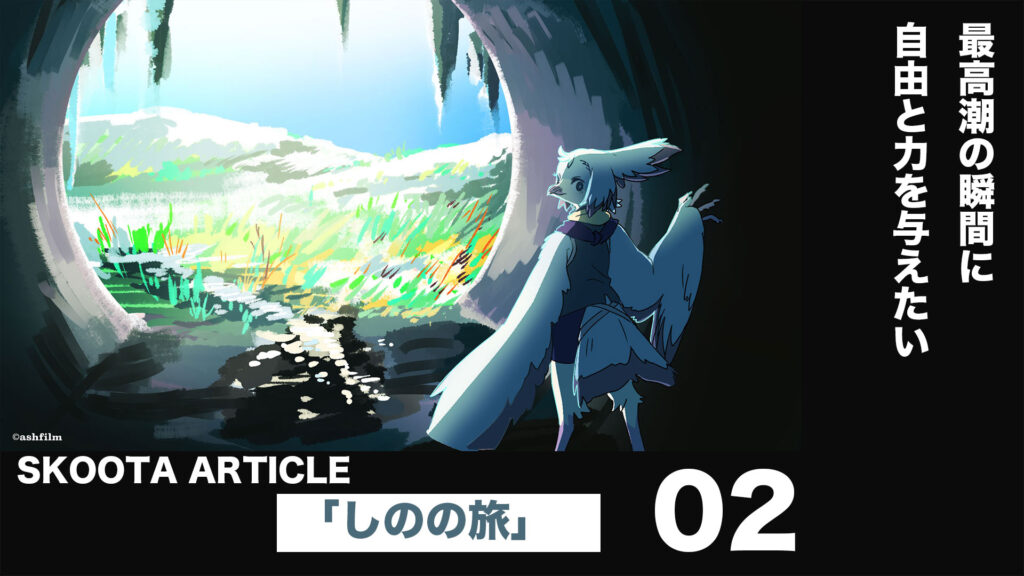
There is a technique called “background animation” where the background is painted properly on a single sheet and the characters are drawn on top of it. However, in order to have more control over the world depicted, I choose to hand-draw each background and add camera movements. By doing so, I can give the feeling to the viewer that “I am free now, everything on this screen is.” That’s why I intentionally start by confining the characters in a dark place, or something along those lines.
So, in terms of the story I mentioned earlier, I don’t really prefer well-made narratives. Rather, I believe that if the emotions and feelings flow smoothly, then the story can be chaotic and that’s fine. Perhaps, many writers tend to make the story logical and enhance the emotional impact of the scenes or situations, especially in commercial anime. But I’m the opposite. I make the story more emotional, but the direction includes things like rhyming or connecting one scene to another, and there is a reason why she became like this on the screen. The direction is very logical, probably in my own work. All of this is to convey the feelings correctly, but the flow of those feelings is a path that only she walks, so there’s no such thing as a well-made story, that’s my argument.
So, how should I put it, it’s a total mess. Because I started this whole thing wanting to do something like “the_Filmament” (Firmament), a full-on encounter with the unknown, you know? She just flies off somewhere when she sees the light. And well, if it ends with the people just watching that, then that’s fine. In order to fully convey the feeling of wanting to fly off somewhere, there’s no other choice but for her to become like that. Well, thinking about it, it might be like a character ride, I guess.
迫田
I think that’s true. Well-made films are usually plot-driven, although it’s not always the case that they are 100% like that. However, it is emphasized that the plot is mature and that the story unfolds in a good way. Well, if the plot is alive, the characters might also come to life.
In that regard, it seems that you, Shino-san, have a sense of freedom in breaking the mold while still adhering to it. It’s like finding freedom in incorporating challenges while still being well-behaved in the main aspects of creating. From my perspective, it seems like you are committed to scenes and individual cuts, which is quite unique. It may not be so special for animators, but expressing the movement of the heart through the movement of the body, and even more so, wanting to express it without using dialogue, is an authentic animator’s presence.
しの
Yes, that’s right. For example, what I did in “Mune no Kemuri” (Smoke in the Chest) is essentially the same kind of reasoning as independent production, but the point is that at the climax, I want to give something that is the best in life, give the ultimate freedom, give the power to overcome the best of something, you know? So, in those moments, I really use my back muscles, but on the contrary, I try to tighten everything up as much as possible until then. Of course, the way I’m talking right now is also like that, but I think it’s necessary to have a good balance, flow, and conclusion to tell a story, right? And for me, there’s a strong fetishism towards things like flying in the sky or going somewhere completely different. Of course, there’s probably a lot of influence from Hayao Miyazaki as well. And there’s also a fetishism towards birds, of course.
How should I say this, to express those things, of course, I do flapping properly, but that flapping has to look like it’s seeking freedom, right? Or it has to be flashy in an action sense when you watch it. I do calculate a bit from the previous scene, but expressing through movement is quite difficult, isn’t it? And I don’t have super extraordinary skills, I’m really making anime out of passion, and there’s a phase of patience to convey that passion.
My life might be quite similar to that. So, there are quite a few moments of enduring movement, like “let’s endure here a bit.” I mentioned that my independent production is a remake of my graduation project, right? During the time I was making that independent production, I was of course at the company, but when you enter as an animator at a company, there’s a phase of being a key animator before you can move freely, right? There’s the work of tracing the drawings made by the key animators and filling in the gaps. Well, it wouldn’t be a lie to say it’s not creative, but you want to get out of that quickly, right? It’s boring, isn’t it? I think everyone puts that frustration into their work, but there are definitely parts of my own experiences included in the storytelling.
What I mean is, in order to express that kind of thing, of course I also do things like flapping my wings properly, but those wing flaps have to look like they’re flying in search of freedom, don’t they? Or they have to be flashy and action-packed when you see them. I do a little calculation from the previous scene, but of course it’s quite difficult to express it through movement. And I don’t have such extraordinary skills myself, I really feel like I’m making anime with passion, so there’s a phase of patience in order to convey that passion.
My life is probably similar in some ways. So there are quite a few moments where I have to endure, like “let’s endure this for a bit.” I mentioned that my independent work is a remake of my graduation project, right? While I was working on that independent project, I was still at the company, of course, as an animator. But when you enter the company as an animator, there’s a phase called “in-between animator” before you can freely move as a key animator. It involves filling in the gaps by tracing the drawings done by the key animator. Well, it would be a lie to say that it’s not creative, but you know, I want to break free quickly, you know, it’s boring. I think everyone puts their frustrations and such into their work, of course, but there are definitely parts of my own experiences incorporated into the storytelling.
迫田
I think the concept of enduring moves applies not only to life but also to works. By creating a strong sense of contrast while enduring, it serves as a driving force for characters to break free and unleash their full potential. It’s like pouring in the feeling of “you’re taking over this world” by using the expression of “back motion,” which may also reflect Shino-san’s longing for the sky. Well, it’s quite consistent in that sense. I believe I’ve heard about what Shino-san is seeking and why it’s not just about well-made things, but about the necessity for characters to stand on their own.