

Guest, Personality
Guest: Naoki Matsuura (松浦直紀)
Currently active as an animation director, director, and animation creator.
Member of the Japan Animation Association.
Born in Tokyo in 1982, currently residing in Kanagawa. Graduated from Musashino Art University, Department of Visual Communication in 2006.
After working in production management at Polyphony Pictures, Production I.G, ROBOT, etc., he became independent. He has experience in various video and animation productions, including TV, commercials, music videos, exhibitions, and live visuals. In 2016, he directed the exhibition video for the Japan Pavilion at the Milan Expo, which won a gold medal within the expo. His first commercial animation direction was for the "Marukome Miso Anime Commercial." Since then, he has also worked on storyboarding and directing for TV series animations.
In 2016, he conducted crowdfunding for his original short film "Fire Making," raising over 1.7 million yen, which was completed in 2021. He has screened it at events, distributed it online, and submitted it to film festivals, receiving nominations and awards both domestically and internationally.
He is currently directing the TV anime "Liar Liar," which will air in 2023. He is also directing a theatrical animation scheduled for release in 2024.
Personality: Yuki Sakoda
After working at a telecommunications company and a general advertising agency, he founded an anime planning and production company, producing videos from music videos to films. In 2021, he moved to Kyoto and began working to promote the entertainment industry there. Recently, he has also been involved in the manga and audio entertainment fields, currently planning and producing audio dramas and webtoons. Additionally, he serves as a producer and advisor for several entertainment companies.
Overall Table of Contents
#01
・The elementary school student dreaming of becoming a manga artist loved "Doraemon: Nobita's Great Adventure"
・"AKIRA" is "violent and beautiful"
・"Parasyte" has become a bible
・The graduation project "A Drop of Water" is about a "boy accepting the world's promises"
・The story of the little person inside the stomach: "My original experience regarding tacit understanding"
・Matsuura's works, which are inspired by humanity bound by premises and sound
・A middle school student influenced by Osamu Tezuka's "Buddha"
・Does the information density of the anime "AKIRA" connect to today's anime production?
・The power of Geinou Yamashiro-gumi in "AKIRA"
・Brother Kura, who participated in the music for "Morning of the Moons" and "A Drop of Water"
・"Half of a movie is music" by director Mamoru Oshii
・Things only I notice in space
・The original experience of "Morning of the Moons" is what I thought while working as a telephone operator
#02
・"Nothing that Japanese anime has cultivated is being utilized" by Satoshi Kon
・What Satoshi Kon bluntly said
・Words from Nobuhiro Aihara
・What "understanding" means in the Japanese anime environment
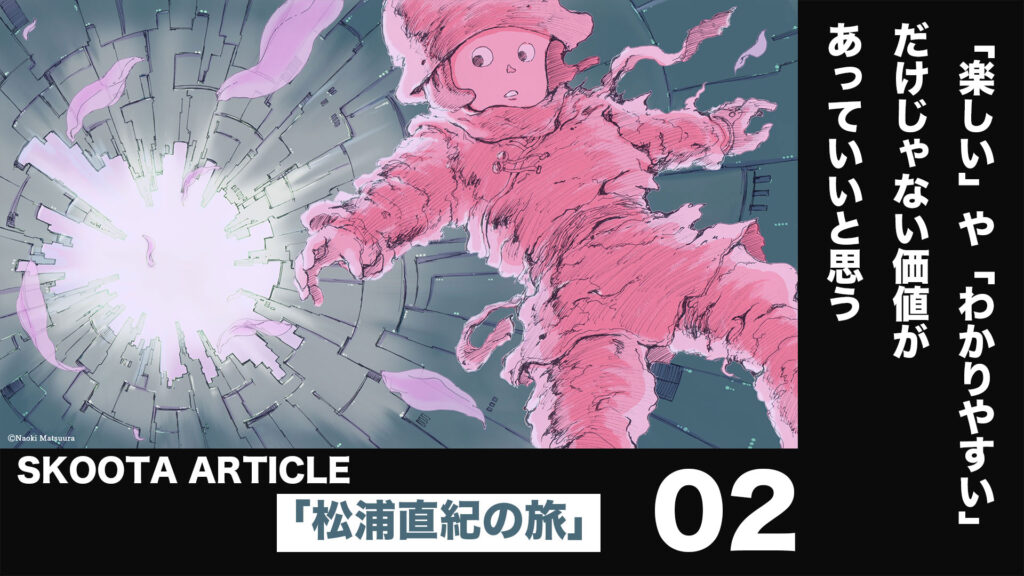
・I think it's okay to have values beyond just "fun" and "easy to understand"
・What remains is expression, and that is tied to physicality
・An era where it's difficult to depict villains
・"The Congress" was a film that demanded viewers to think
・I got hooked on "The Five Star Stories"
・An episode experienced shortly after graduating from university with director Mamoru Oshii
・Gained courage towards the existence of "director"
・I'm glad I did production management!
・Reflecting on four years at Production I.G
・An episode with director Mamoru Oshii and Atsushi Takeuchi
・"You can save what you want to do for next time"
・Director Mamoru Oshii, loved by all the staff
#03
・About "Fire Making" ・The persuasive power conveyed from the blacksmith scene
・A work created by one producer and one director
・An episode about UQiYO's participation
・Let's talk about the relationship between works and physicality based on "Fire Making"
・The lost body seen from the contrast structure of the development of mechanical civilization and old civilization
・I want to pick up what is being lost there
・Moved by the sharpness of scissors
・What is born between the body and objects
・Observing what has continued for 150 years
・A little crowdfunding story with Kappi
・It's better to increase the heart that feels beauty than to increase beautiful things
・Working hard towards the work scheduled for release in 2024
#02 Begins
What Satoshi Kon Bluntly Said
Sakoda
I think we could talk for hours just about "Parasyte" and "AKIRA," but while heading in that direction, let's return to discussing Matsuura's works. I hope to get into what I wanted to talk about in Episode 1. At this point, Matsuura-san has graduated from university, worked in various positions at various companies, and is now directing anime, with his latest project being a film set for release in 2024. Throughout this process, I believe he has met many people in various places.
In the notes I received, there are various encounters with different people, and the words I remember from them, or rather, the words that left an impression on me from what Matsura-san said, are written down. I have many questions like, "What does this mean?" and "How did Matsura-san interpret this?" There are quite a few of them. I don't think these were said verbatim, but by the way, is it okay if I read this out loud?
Matsura
It's totally fine, no problem at all.
Sakoda
This memo contains words that Matsura-san remembers, such as "Nothing from what Japanese anime has cultivated is being utilized" and "You should just learn to love what you have to do," which came up in a conversation with Satoshi Kon. What was the context or story behind this?
Matsura
First, the first one is something I was told directly, and the second is something that Satoshi Kon wrote on his website while he was teaching at Musashino Art University.
To talk about the first one, the last project I worked on at I.G as a production assistant was a full 3D work called "Hottarake no Shima." After finishing that job, I quit the company and started job hunting, wondering what to do next. Since I liked Satoshi Kon, I emailed him through his homepage, and he replied, "Come play." At that time, he was at Madhouse working on "Millennium Actress." When I brought the flyer for "Hottarake no Shima" and said, "Oh, I worked on this. If you're interested," his first line was that.
What he said was about the CG model of the main character, a girl, which had quite a dark shadow. He looked at the flyer and immediately said, "Why is the character's shadow black?" He added, "Nothing from what Japanese anime has cultivated is being utilized," with a bit of a wry smile.
Sakoda
Was it like a key visual illustration?
Matsura
Yes, that's right. At that time, we worked really hard with the CG team, but when he said that right off the bat, I was like, "Oh no," but I thought, "Well, that's true, I see."
Sakoda
That really left a strong impression on you, didn't it?
Matsura
Yes, it was surprising how quickly he said it. I would have thought, "Oh, I worked on this, good job—I'll go see the movie," but there was no small talk at all. (laughs) I had just quit I.G and was wandering around job hunting, and I ended up asking Satoshi Kon for life advice. After that, he said, "Let's go for drinks," and took me to a nearby izakaya. We talked about various things, and he said, "You're interesting. Come again."
Sakoda
Satoshi Kon started with manga and then moved to anime, right? It seems like both of you, rather than being pure anime fans, had a love for manga and things like sci-fi, so there was a wavelength that matched.
Matsura
So when I heard the news of his passing, it was really shocking. When we went out for that meal, he exchanged phone numbers with me, so I still have Satoshi Kon's number. I can't delete it. I think of it as a keepsake. But that was really the closest I got to talking with him.
From what I hear, he was someone who enjoyed talking to young people and often hung out with those in the anime industry, teaching them and sharing experiences. He was known for being very caring towards those younger than him and was well-liked.
Sakoda
That's right. I remember knowing that "Millennium Actress" was left unfinished while I was working in a completely different profession, and I wondered if it would ever be completed. I even contacted the producer about it. Now that I've made a few films and projects, I understand that without a core person, a work cannot be completed.
At that time, I spoke with the producer, and they said, "This is a work that cannot be done without Satoshi Kon," and I understand that now. No one can replicate it in the same way, and whether it's good or what is being sought after to imitate someone else's shadow when that person is not there is something I really get now. Technically, it's also completely different. Even looking at the storyboard, it's amazing. I envy the history that Matsura-san has within him.
Matsura
That was really just that one time, but it was the closest I got to talking and going out for a meal. It was really just one meal.
Sakoda
Speaking of which, among all those encounters, there was also Aihara-san at the Hiroshima International Animation Festival.
Matsura
Aihara-san too...
Sakoda
There’s an episode where he said, "I can feel the music," and that really connects back to what we were talking about earlier.
Matsura
As I wrote in my notes, back when I was still a first-year university student, I went with some seniors from that circle, and what I showed them was a photo of a piece I created for a design assignment. At that time, I tied clothes that I wore daily onto a doll that was about the same size as me, and I wrapped the clothes up in a messy way with string, essentially creating an object that represented my own life-size self. It was like my own doppelgänger. I made that piece with that concept in mind, and when I showed it, Mr. Aihara said, "Oh, I can feel the music in this," which made me really happy.
Then, I also saw Mr. Aihara's works at film festivals and thought, "Wow, this is amazing." It was like I was touching a profound world and realizing that there are expressions like this. The year I attended, there were many international animations showcased there, and it really opened up my perspective, as until then, I had only been exposed to the kind of anime that was on TV or in movies, the so-called Japanese anime. But as I mentioned, I really like Raúl Servín's work.
Also, as I wrote in my notes, Ryan Larkin's "Walking" was something that made me think, "What is this?" It was something I could watch for a long time. Once I entered university, I was mainly exposed to European works, particularly what is referred to as "art animation." This term "art animation" has its pros and cons, and while I explained it simply, I try not to use it too much myself. I started watching a lot of short animated works from overseas, which led me to think, "Okay, let's create something like this, or something like that."
I think there are values beyond just "fun" or "easy to understand."
Sakoda
In a previous episode featuring Miku Mizue, a similar topic came up. After entering university, through the act of creating works and submitting them to festivals, I first learned about categories like abstract animation and experimental animation. I think this realization about the breadth of animation and its capacity is significant. Japan has a unique environment for animated visuals. I say "animated visuals" intentionally, but symbolically, it's still "anime." This anime, I believe, has a rich content of meaning. In other words, understanding the meaning is a prerequisite, and meaning must be conveyed. It has become a medium where it's okay to be cut off if the meaning is unclear.
Matsuura
This is probably a deep-rooted topic, but it’s not always about being easy to understand or just being fun. Just like how I was shocked after watching "AKIRA" and stopped eating pizza, it’s okay to feel nauseous, irritated, or confused. However, as more people get involved and more money is at stake, there’s a tendency to prioritize public perception, trying not to offend anyone. With the rise of social media and cancel culture, more people are becoming sensitive to this.
Back in university, there were many outrageous works showcased at school festivals. There were pieces that were definitely not suitable for TV, some so extreme that I can't even put them into words. There were also many people expressing abstract ideas. But I think it’s important to direct your body and time towards those incomprehensible things and to genuinely feel and think about them.
Sakoda
I agree. I think a keyword that will come up later in our discussion is "embodiment," which I believe is also a significant concept for you, Matsuura-san. I've been thinking a lot about embodiment in recent years.
I don’t think this applies to everyone, but when using animation as a form of expression, what can be conveyed is closely related to embodiment. The words used to describe feelings like "nauseating" or "soft" are very much tied to the power of conveying something related to embodiment. Also, what tends to remain in memory is, in my experience, more about "expression" than "meaning content." It’s expression tied to embodiment.
For example, the Catbus from "My Neighbor Totoro" is quite symbolic. I don’t think anyone really remembers the meaning conveyed by that animation deeply. The signified it wants to convey isn’t that strong, but the feeling of fluffiness and the refreshing sensation of the wind blowing through remain in memory. Similarly, the slight discomfort from "Princess Mononoke" also lingers in memory. The discomfort from "AKIRA" likely remains with you, Matsuura-san, more than the story itself. So, while leaving a lasting impression isn’t necessarily the main point, I believe that what remains is expression, and if that expression is tied to embodiment, that’s even better.
Matsuura
When talking about "AKIRA," it’s really just about fighting, right? Childhood friends turned into a biker gang and are just fighting.
Sakoda
In terms of meaning content, if you ask, "What’s the story?" it’s about fighting with childhood friends.
Matsuura
It just involves various societies, militaries, and nations, and the scale of the conflict just keeps getting bigger, and it’s not just that it’s depicted with overwhelming detail and resolution. So, I don’t think Mr. Otomo is trying to convey something noble in terms of the story. It’s just about chasing the current situation with overwhelming detail. As someone who has been deeply immersed in things like 'Doraemon' and loves superhero shows like 'Kamen Rider', I was drawn into a world that isn’t about defeating evil that schemes for world domination, it’s not a world of good versus evil, but rather a more murky world and feeling.
So, looking back, I really like both Sentai and Kamen Rider now, and while I’m not following the main series, I’m just casually looking at the designs. Every year, I look at the settings and situations, and just like with Marvel, it’s become really difficult to portray villains. Concepts like world domination or exterminating humanity have stopped being seen as evil. In other words, groups that raise such motives can no longer be depicted as villains.
Recently, I really liked Marvel's 'Doctor Strange', and I watched the sequel, the Multiverse one, but I haven’t seen the drama. Essentially, Scarlet Witch becomes a sort of antagonist, and while it results in the destruction of the world, her motives as a villain are simply wanting to be with her family or spend time with her children. It’s quite ironic that this becomes evil. Watching that, I felt deeply that even Marvel has reached a point where they can’t treat world destruction or extermination of humanity as evil anymore.
Sakoda
Well, under Disney, it’s hard to depict that now. There’s a sense of diversity, and everyone has their own sense of justice, and there are various perspectives that need to be shown to explain why someone has come to a certain judgment. I really feel that this is a significant trend in entertainment right now.
But there are also some good ways of depicting this, and if we talk about Japanese anime, 'Gundam' has been doing that all along. Each character has their own circumstances, and while it might seem like a tragic ending or a ruthless decision from one perspective, from another angle, it can be seen as that person’s true sense of justice and their very earnest decision-making. I feel like the world is moving in that direction now. So, it feels like 'Gundam' is making a comeback.
Matsuura
That’s right.
Sakoda
In the midst of that, I’d like to introduce a song. Is there a song you’d recommend for us to listen to?
Matsuura
I’d like to introduce Bob Dylan’s “Forever Young,” which goes back a bit in time.
'The Congress' was a film that demanded viewers to think
Sakoda
Yes. You just listened to Bob Dylan’s “Forever Young.” What’s the story behind this song?
Matsuura
It’s not from real-time, but there’s this rather strange movie called 'The Congress' that I really love.
Sakoda
I haven’t seen it, but it looked interesting from the summary.
Matsuura
Oh, it’s amazing. When was it, around 2015 or 2016? It might connect to the earlier discussion about justice and evil, but I felt like I was hit on the head with a hammer. It criticizes animation using animation, which is quite new. I really want people to watch the main film. The theme song, or the one that plays at the end, is sung by the lead actor, and I’m not too familiar with it, but if I’m wrong, I apologize. It’s a female vocal that plays, and when I found out, “Oh, that’s a Bob Dylan song,” and I looked up the lyrics and background, I thought, “Ah, that’s why they played it at the end,” and it was a song that really resonated with me.
Sakoda
Well, there were a lot of things I hadn't seen in the notes I got from Matsuura-san, just like with "The Congress: A Future Conference." I watched what I could, but there are still some things I haven't seen yet, so I’d like to talk about various things when I do.
Matsuura
"The Congress: A Future Conference" is amazing, isn't it? I could probably talk about it for hours. (laughs)
Sakoda
Just to briefly return to the previous topic, since I haven't seen "The Congress: A Future Conference," this is purely a guess. But I think there’s a message that they want to convey, typical of this kind of work. The form of expression is probably interesting, but the meaning is strong; there’s something they want to communicate, and it seems to handle quite real issues metaphorically. When I think about it, works with such prominent meanings are really easy to discuss.
Easy to discuss, or rather, they invite deep analysis and can easily become topics of conversation with various people. There’s a trend where the ease of discussion can determine the quality of content, and things that really hit hard but are hard to articulate or understand tend to end the conversation quickly, like, "That was nice," and that’s it.
This seems to have a certain compatibility with social media culture, both good and bad. It doesn’t become controversial because it can’t be articulated in words. But it feels like it circulates easily with comments like, "This is good," or "I like it," and it doesn’t lead to debate. That’s why, when I create things, I often find myself thinking more about what I want to convey rather than how to convey it, because strengthening the meaning is quite straightforward. However, I do think how to convey it is very important. There are various ways to deliver the same message, whether through singing, speaking, or storytelling.
Matsuura
As for the film "The Congress: A Future Conference," what I felt was that it really demands the viewer to think. It feels like it’s asking, "So, what will you do?" and I find myself thinking about that continuously.
Sakoda
I’m still in the process of receiving that message and continuing to think about it.
Matsuura
I think it’s that kind of work, but on the other hand, depending on how you look at it, the themes or criticisms can be very readable. However, stripping all that away, there’s a lingering question of, "So, what will you do in the end?" And I think it’s somewhat similar to "Parasyte." After finishing the original "Parasyte," you think, "Oh, it’s over. But what will I do?" It’s definitely not just, "That was a nice story, the end! Happy ending." Broadly speaking, it raises questions like, "What will humanity do from here?" It can also be seen as a story about family love, issues of science and technology, and societal systems. It has a lot of implications. It’s a truly mysterious film.
Sakoda
You mentioned you got hooked on "Five Star Stories." It seems like what underlies it all is that Matsuura-san likes multi-layered, multi-faceted, and complex narratives.
Matsuura
Yes, "Five Star Stories" is amazing. It’s still somewhat of a myth. The timeline determines the ending, and Nagano-san has been depicting that history for thousands of years, and it’s still ongoing, with no end in sight.
Sakoda
It truly is a myth. It traces the entire history of human existence while telling a story. Myths do that, right? If you just convey the actions of people, no one will pass them down, so they have to be told in an interesting way. Various things are layered into the narrative, including difficult or unspeakable topics.
Returning to the previous topic, as Matsuura-san continues to work on client projects while creating independent works, the use of animation as a visual expression, along with various music, allows for a multitude of messages to be conveyed in different ways. I think it’s the media selection that is closest to his own sensibilities.
Experiences with Director Mamoru Oshii Right After Graduating from University
Sakoda
Returning to the series of encounters Matsuura-san has had with various companies and projects, there’s an episode with Director Mamoru Oshii during "Sky Crawlers." It’s interesting because, according to Matsuura-san, Oshii said, "I haven’t opened Photoshop in years." This line alone doesn’t give me any context, though.
Matsuura
It was probably when I was waiting for a taxi with the producer after a meeting, talking about something like Photoshop, and then Oshii-san said with a wry smile. At that time, I had only been out of university for about one or two years.
Sakoda
Ah, that period.
Matsuura
I was quite surprised. "Oh, so directors don’t have to use Photoshop," I thought (laughs). It was a revelation that you can be a director without using Photoshop. I had entered university and became a slave to Adobe, learning to use Photoshop and After Effects, coloring and animating things myself, saying "Here I am!" and claiming, "I became a director!" But Oshii-san was different.
Well, he wasn't originally a painter, so I guess that’s his stance. For someone like me who holds Miyazaki-san in such high regard, it was a profound realization that "not drawing" or image processing doesn’t mean you can’t be a director. Oshii-san didn’t say it to teach me anything; he just casually mentioned, "I haven’t used Photoshop in years," but for me at that time, it was quite a shocking statement, as I realized, "Oh, directors can work without using Photoshop."
Sakoda
But that was a phrase that really moved Matsuura-san. Because if I had continued to hold Miyazaki Hayao in such reverence, I would have thought that you couldn’t be a director unless you could draw at that level.
Matsuura
Exactly. So even though I graduated from an art university, my drawing was all self-taught, and while I had to draw for exams like image illustrations, it wasn’t a department that required serious skills in design or traditional painting. I could draw to some extent, but I didn’t have the skill level of someone who was seriously pursuing it.
But when I thought about wanting to work in anime, I considered, "Which anime company should I join?" and ended up doing production management and animation. This could get complicated, but as an animator, you really have to work on a per-piece basis, and I realized, "Ah, I can’t make a living just on my salary," so I thought, "Well, maybe I should start from production management," which was a bit of a process of elimination.
Sakoda
In making that choice, do you feel that being able to see the production side and the producing side helped establish your unique position now, Matsuura-san?
Matsuura
Yeah, I’m glad I got into production. (laughs)
Sakoda
I feel like many people want to hear that story. When I listen to students, they often think they have to be able to draw exceptionally well to succeed, but there are also quite a few who want to work in the anime industry even if they can’t draw that well, so they think about going into production management. Since you’ve been through that as a senior and are now a director, I think many people would like to hear your thoughts, Matsuura-san.
Matsuura
Well, in the end, I think it’s about whether you’re okay with it or not. In my case, I have this personality where I enjoy talking to people, and to go back a bit, I did theater in high school, so I liked being in front of people and interacting, so I had no resistance to it at all.
But I think for those who aren’t naturally good at that, it’s better to focus on honing their drawing skills. For people like me who enjoy talking to others, coordinating schedules, and managing meetings, it might be good to give it a try. But ultimately, the barriers to entry are low. You need a driver’s license, but there aren’t any specific qualifications or licenses required.
Sakoda
Well, nowadays, it seems like there are quite a few places where you might not even need a driver’s license.
Matsuura
That’s true, isn’t it? Back when I was in production, I would say, "I want to be a director," but I was struggling with how to actually become one. The producer who helped me the most was leaving IG, and we went out to eat together. During that conversation, there was a director of a TV series—I'll keep their name private—but there was someone who just didn’t do their job. They would slack off, say they’d deliver something on a certain day and then not do it, and would leave saying they were feeling unwell. This was a veteran who was doing storyboards and directing.
So, when I had that last meal with the producer before they left, they said to me, "You should have drawn the storyboard and shown it to the director when A-san, let’s say A-san, didn’t deliver." They told me, "It doesn’t matter if it gets used or not; I think you should have done it that way." That was a huge shock, like a lightning bolt. I thought, "Oh, I could have done that." Essentially, I realized I could have taken the job from that person. If the storyboard artist isn’t delivering, then I should just draw it myself and show it to the director, saying, "I drew this, what do you think?"
I thought, "Ah, I see." It’s clear that such things are allowed in the industry. They welcome anyone who comes in. I realized that if you don’t go after opportunities, they won’t come to you. That’s a story I still remember very well. I still occasionally keep in touch with that producer via email, and they supported me during my crowdfunding campaign. They still work at IG, and I’d like to go out for a meal again and see how they’re doing.
Sakoda
From what Oshii-san said, I rewrote my own image of being a director, and through conversations with various producers while working in production management, I think the desire to be a director grew stronger in Matsuura-san over those four years. When that feeling of "I want to be a director" overflowed, you talked to Ishikawa-san, right?
Matsuura
Once a year, there’s a meeting with the president, and during that time, he bluntly told me, "You’re not suited for production." I was like, "Well, yeah, haha," and then I said, "I want to be a director, I really do!" Ishikawa-san replied, "If you want to be a director, go out there and work hard."
As a premise, I still love IG, and I deeply respect President Ishikawa and everyone who has helped me. However, as a production manager, I was a full-time employee, and I was told that if I wanted to stay, my salary would be reduced. Then, I was told that if I were to leave a year later, my salary would be increased. So, when asked what I would do, I immediately replied, "Oh, then I’ll quit," and I ended up leaving a year later. It seems the company was also in a precarious situation at that time, and I was pushed to make that decision, but I answered right away. I thought it would be better not to stay long.
In the end, I was called back for one project as a director, so I was able to help out. President Ishikawa is an interesting person. Oh, but someone once told me, "You resemble Ishikawa-san." I felt it was presumptuous of me to say this, but there’s definitely something a bit off about me, yet I’m not wavering at all.
"You can save what you want to do for next time."
Matsuura
Another thing I wanted to talk about is a quote from Oshii-san regarding a conversation with Atsushi Takeuchi. Takeuchi-san is a director and is also very skilled in mechanical design. During 'Sky Crawlers,' I was essentially in charge of production for Takeuchi-san. He was responsible for several layouts of cuts featuring mechs, but it was taking quite a while. He tends to be a bit slow with his work. When we were at a point where we couldn’t extend the schedule any further, there was a serious meeting with the producer at that time, Oshii-san, myself, and Takeuchi-san. During that meeting, Oshii-san told Takeuchi-san, "You can’t do everything you want in one project; save some of those desires for the next one."
Then, with a bit of a wry smile, he said, "Hey, Take-chan, I hear you’ve become an adult recently, but to me, you’re still a child." He added, "You can’t do everything you want at once, so just save some for next time," encouraging him a bit. Takeuchi-san was silent and listened, but the following week, all the layouts were completed.
Hearing that, I thought, "Wow, that’s amazing." It wasn’t about saying, "Come on, do it," or "I’ll pay you," but rather, it was a gentle nudge, a pat on the shoulder, walking alongside him at the same level. I remember Oshii-san’s way of speaking very well from that time. While saying he was still a child, he also talked about saving some desires for the future, and I think that sparked something in Takeuchi-san.
I have no way of knowing how Takeuchi-san felt at that moment; he might have thought, "Damn it, this guy," but the fact that he delivered in the end means he put his heart into it. Oshii-san is often described as a people person, and I’ve seen how he engages with staff, encouraging them. The main staff all seem to like Oshii-san. When talking to people from any section, they’d say things like, "I have to do this because Oshii-san is counting on me," or "Oshii-san is such a handful," and "I’ll take care of it." Everyone seems to gather around him, and they all look like they’re having a great time. There were tough times, but they’d say things like, "What a handful," or "I’ll do it," and the staff really comes together. Seeing that made me realize, "Ah, this is what’s important." While there are places that attract people because of someone like Miyazaki-san, who is an incredibly talented animator, I learned a lot from working with Oshii-san and observing how he interacts with those around him.
Sakoda
During the time I spent with Oshii-san, it might have cultivated Matsuura-san's ideal image of a director.
Matsuura
Yes, as I recall while talking, I originally loved the works, and I learned a lot just from observing the everyday way of speaking and working.
Sakoda
I think it was a kind of historical page that can only be spoken about by someone who was there, and I’m really glad that it could be recorded.
Matsuura
Yes, Takeuchi-san might get angry if he hears this, haha.
Sakoda
I can’t casually say I understand Takeuchi-san’s feelings, but I definitely think that if you’re going to do something, you want to put everything into it, and that’s what makes a good creator. From the outside, I only know what I hear from the media about Oshii-san, so I haven’t followed him deeply and don’t know much, but from what I’ve heard now, he seems to be a very adaptable director.
Matsuura
That’s absolutely true. If you only look at how he speaks in the media, he might seem very serious, mumbling about difficult things and always looking grumpy, but it’s completely the opposite. He’s very charming, laughs a lot, talks a lot, and he doesn’t act arrogant at all.
Sakoda
I’ve heard that Oshii-san also had times when he couldn’t create works, and I think he intuitively understood that "works exist through connections with people." If you become too proud, you can end up isolated, and suddenly opportunities for the next work might not come. It’s all about people, after all.
Matsuura-san, through your time at IG and the various experiences you had there, I think there were many things in between, but regarding the work 'Hizukuri,' you mentioned crowdfunding earlier. I’d like to hear more about how crowdfunding became a catalyst for starting the work 'Hizukuri' in Episode 3.
#03 to be continued