

This article can be listened to as a podcast on the following media.
Guest and Personality
Guest: Shiohigari
Illustrator / Manga Artist
Born in 1989. Resides in Tokyo. Known for humorous and romantic illustrations of girls saying witty lines, drawn in a soft touch. Self-proclaimed "Cheap Artist." Started posting illustrations on Twitter and live streaming on Ustream during university. After graduating, she worked at a material manufacturer, but after her illustrations and short comics created during work hours went viral, she decided to leave and become a full-time "Cheap Artist."
Personality: Yuki Sakoda
After working at a telecommunications company and a general advertising agency, he founded an anime planning and production company, producing videos from music videos to films. In 2021, he moved to Kyoto and began working to boost the local entertainment industry. Recently, he has also been involved in the manga and audio entertainment fields, currently planning and producing audio dramas and webtoons. Additionally, he serves as a producer and advisor for multiple entertainment companies.
Overall Table of Contents
#01
・What is a Cheap Artist?
・Naming born in the era of interesting titles
・Desire for expression born during university days enjoying USTREAM
・Creative works collaboratively created on the internet in the 2010s
・"LOVER SOUL," the ending theme of Shiohigari's life
・Aiming for episode talk at all times
・Creative works woven during the four-year university and material manufacturer working years
・Rational and efficient job choices
・Starting a Twitter series around the fifth year of working
#02
・While wanting to live solely as a creator someday
・Riding the wave of creators emerging from Twitter
・Believing that success requires luck
・Changing the pachinko machine
・About Shiohigari Girls
・Creative behavior in the SNS era
・How does Shiohigari view current creativity from a perspective of efficiency and rationality?
・Adopting a survival strategy for the weak
・Abilities thought to be normal were not normal
・Ultimately wanting to talk only through metaphors
#03
・About high-context creativity
・Referencing Machi Tawara's words
・Always aiming for the right balance of the times?
・What is the good balance in Adachi Mitsuru's works?
・Is there no anxiety by not speaking in detail?
・Showing a gap to the Grim Reaper
・About the webtoon currently being worked on
・Are Shiohigari's works close to waka poetry?
Riding the Wave of Creators Emerging from Twitter
Sakoda
Shiohigari, who has lived through a route that is not typical for creatives and has pursued her studies, is now working in the creative field. For those who are looking for such a path or are vaguely thinking about wanting to do something creative but are unsure how to proceed, I believe Shiohigari's experiences are very valuable, so I hope to continue exploring this area.
After graduating from university, you worked at a material manufacturer while also creating illustrations. What was the frequency of your posts like during that time?
Shiohigari
Oh, but back then, it might have been close to every day.
Sakoda
Do you think posting every day was important in hindsight?
Shiohigari
Yes, looking back, I think it was important. I believe that being seen every day contributed to people getting to know me. Increasing the probability is crucial, so in that sense, posting every day is an effective method.
Sakoda
But at that time, since you were working, you were doing content that was easy for you to create and wanted to post, right?
Shiohigari
Yes, I was able to make time for it, and I had a certain amount of it, and I had passion back then. It was just really exciting to get reactions, so posting every day didn't feel like a hardship. It was fun to draw and post every day and receive feedback.
Sakoda
I think you mentioned that the work at the material manufacturer didn't quite suit you or was boring. After continuing that job for a few years, did you think, "I definitely want to pursue a creative path," or did you have moments where you thought, "Maybe continuing in materials is okay?"
Shiohigari
Ah, yes. I always thought that someday I wanted to work solely as a creator. However, on the other hand, looking at reality, I hadn't been drawing for that long, so I didn't have the strength in my illustrations. So, I was still vague about what I could do in that job, and I struggled with that trade-off.
Sakoda
It's hard to imagine what kind of work is involved in creativity and what kind of products can generate income, right?
Shiohigari
That's very true.
Sakoda
I think this is a challenging point when aiming for work in the creative field. When you're a salaryman, you can calculate that if you work at a company and do what you're told during specified hours, you'll receive a certain salary each month. But in creativity, it's not like that, and I think that's part of the difficulty in pursuing it.
Shiohigari
That's right. I feel lucky about that, as it was a time when creators originating from Twitter were gaining momentum. Nowadays, you could say it's similar to something like Chiikawa. That has become a huge and amazing content, and in that way, many people started sharing characters, illustrations, and manga through social media. Various advertising agencies and others discovered them and reached out. It was truly a time like that.
Also, with the spread of LINE, it became possible to sell LINE stickers. The LINE Creators Stickers were introduced, allowing individual creators to create their own stickers through a review process, something that previously only companies could do. I think this significantly increased the means for creators to make a living.
Sakoda
I think the emergence of smartphones marked a turning point for Japan's industry. The ability to accelerate free competition through smartphones was significant, but Japanese platforms didn't really embrace that side of free competition. For instance, LINE stickers are one example, and at that time, Docomo's i-mode was a major platform offering various games and services, but it didn't allow users to freely enter and post content.
Shiohigari
That's true, indeed.
Sakoda
In that context, there’s the issue of UGC (User Generated Content). I feel that there was a failure to adapt to the era where user-generated content became the leader. However, as the times changed, Shiohigari started posting around 2010, and their influence grew steadily, which was reflected in their follower count. This led to new digital agencies of the era reaching out to collaborate.
Shiohigari
Yes, exactly.
Changing the Pachinko Machines
Sakoda
Regarding those numbers, you can't just create them all of a sudden, right? Do you feel like you've built up to that point over time, or does it feel like it suddenly increased at some point?
Shiohigari
I definitely focus on spreading the numbers. I still do, but fundamentally, I believe success is largely about luck. It's all about big luck. Luck is important, and it's not about trying to increase that luck; it's about coincidence. Coincidentally catching someone's eye is a big part of success. So, it's not guaranteed that good things will be discovered; it's really a game of chance.
I often say it's like changing the pachinko machines. I'm not very familiar with pachinko, but if you keep playing the same machine, you're not going to win. There are probably certain machines that are likely to pay out. So, it's important to change the machine and keep trying instead of just clinging to the same one and saying, "I'm not winning."
Sakoda
I see. That rational thinking seems to be a common trait among creators emerging from social media.
Shiohigari
Yes, I think so. Everyone seems to be quite clever about how they market themselves and have a certain shrewdness.
Sakoda
If there's one thing that sets them apart from existing creator images, it's the strong sense of "delivering directly to the users."
Shiohigari
That might be true. That's probably why it's easier for them to go where the response is.
Sakoda
As we discuss this, let's take a break with a song, and we can delve deeper into the conversation in the second half. If you have a song you'd like to recommend, please let us know.
Shiohigari
Yes, please play "Romantic Time Bomb" by ONIGAWARA.
About Shiohigari Girls
Sakoda
You just heard "Romantic Time Bomb" by ONIGAWARA. Shiohigari, do you have any episodes related to this song?
Shiohigari
Yes, indeed. This song holds a lot of meaning for me. It was the ending theme for the web anime "Shiohigari Girls: Bolognese," which was based on my illustrations and released in 2018.
Sakuta
This is it, right? It might not be viewable right now.
Shiohigari
That's right, it's currently on hold for public viewing.
Sakuta
Yes, but when I saw this, I thought the ending theme was incredibly dance-heavy.
Shiohigari
Yeah, exactly. The ending is just packed with energy. The main story is only a few seconds long, yet the opening and ending are fully fleshed out, and the ending is so energetic, featuring three girls dancing and singing. So, in some circles, that ending was considered the main part.
Sakuta
I think the main story is the creative work that Shiohigari-san has posted on Twitter and Instagram, which has been animated. The contrast between the relaxed animation and the urgency of the ending creates a rich experience in just one minute.
How does Shiohigari-san's efficiency and rationality reflect in current creativity?
Sakuta
The story behind choosing the material company was really interesting, and I think Shiohigari-san's personality and way of thinking are reflected in that.
Shiohigari
That's right. Basically, I tend to be quite efficiency-oriented and rational.
Sakuta
It seems like being focused on efficiency and rationality might be seen as contradictory from a creative perspective. However, I feel like these two aspects will coexist in the future, and that might become the standard.
What are your thoughts on that, Shiohigari-san? I know this is a bit of a rough question, but while you admire the creatives from the past that you looked up to, how do you think the upcoming generation of creatives is approaching their work, especially in light of your own experiences?
Shiohigari
Well, I think those who create something through a build-up of irrationality and a bit of madness are really strong. There are people who have loved drawing since childhood and have dedicated themselves to it, and I feel like I can't compete with them.
So, I tend to feel like I'm operating from a perspective of survival as a weaker party. When I was a company employee, I thought my abilities, like communication skills, general knowledge, and mental stability, were normal. But in reality, those were super special abilities. Everyone in my company had them, so I thought I was just average. However, once I transitioned to a creative role, I realized those were indeed super special abilities.
For instance, waking up at 6 AM and being at work by 9 AM, keeping to schedules, and responding to emails—these are things that anyone can do, but not everyone actually does. That's why I feel like those abilities are really helping me now.
Sakuta
It's about communication skills and maintaining mental stability, which could be described in different ways. Having general knowledge helps too. Ultimately, since creativity is tied to industry, there must be some purpose behind it, and usually, that involves creating something that leads to financial gain.
There are people who enjoy what you create, and you move forward with the premise of delivering something to them, ideally to a large audience. Considering this principle, the engine that drives creation is important. While there are many moments where a single, passionate individual is crucial, the importance of general knowledge, communication skills, and mental stability cannot be overstated. In terms of survival for the weaker party, adapting oneself to the environment is also significant.
It's like changing a pachinko machine; you need to go to the right place and play. You could also say it's about competing in your own arena. I think that freedom has emerged. In the past, especially in creativity, there were strict rules about how to express creativity, and there were few media outlets to showcase it.
Shiohigari
That's true.
Ultimately, I want to talk only in metaphors
Sakuta
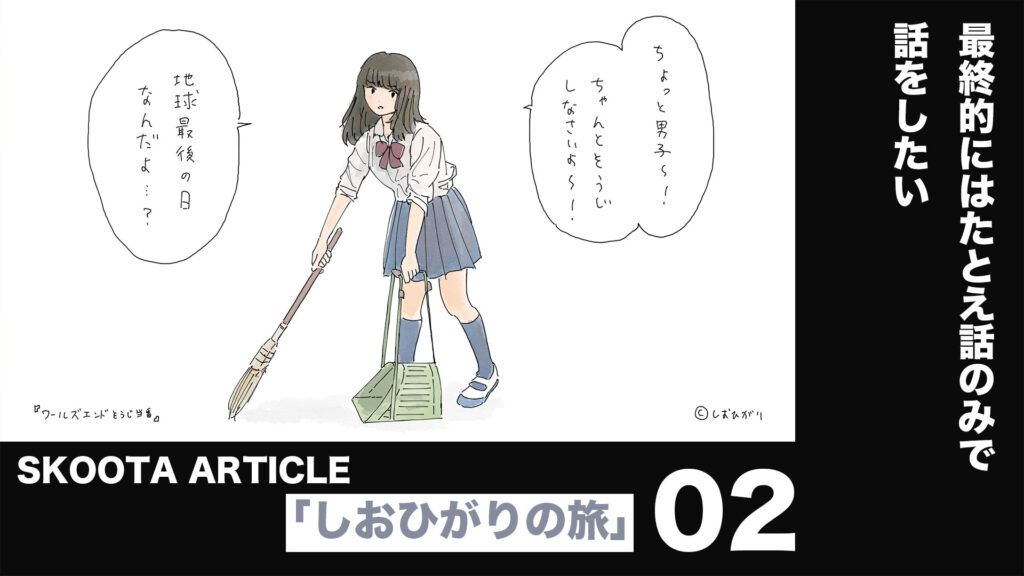
By the way, I want to ask you something. When I look at some of your current creative works, there's a lot of whitespace. It's not that backgrounds are drawn; the visual information conveys that the characters are girls, along with their clothing, hairstyles, and subtle movements.
Doing something with words and actions seems to contradict the corporate world, where you often leave a lot unsaid. I wonder if this reflects a desire to understand each other without having to articulate everything. Can you share how this aspect of your creativity came to be?
Shiohigari
Yes, I do enjoy metaphors. I would ultimately like to communicate only through metaphors. In "Star Trek," there are the Tamarian aliens who only speak in metaphors. In the episode "Darmok," the Tamarian people communicate using references from their own mythology, which makes it incomprehensible to humans. Even if translated, humans wouldn't understand the original myths, so communication fails. Captain Picard manages to communicate effectively, leading to a happy ending, but ultimately, I want to be like the Tamarian aliens.
Sakuta
It’s understandable as words, but the meaning is completely lost, turning it into a kind of code.
Shiohigari
In short, that's what it is. The Tamarians say something like "Temba, arms wide open," but that kind of expresses a meaning of welcome, I believe. However, I don't know who this person Temba is, and the meaning of "arms wide open" is also unclear. If you knew the myth, there might be a scene where Temba is welcoming someone with open arms, but since Earthlings don't know about that, the translation of the words can be done, but it feels meaningless.
So, for example, if we were to say "Romeo and Juliet on the balcony" in Earth language, you would get a somewhat romantic impression, right? It's that kind of feeling. The Tamarians talk about such stories, but my work tends to be like that too. It often leans towards Tamarian language. Therefore, fundamentally, I really want to avoid explanations as much as possible. I want to go for the atmosphere.
However, it does limit the readers quite a bit. So, when I'm drawing those kinds of things, for example, there are events like Design Festa, where I draw portraits. When I'm drawing portraits, customers come up and say, "I'm a huge fan of Shiohigari," and when I ask, "What are you doing?" they say, "I'm in the literature department at Meiji University." I respond with, "Oh, I see," and then say, "Next person, please," and another person comes up and says, "I'm a huge fan of Shiohigari," and when I ask, "What do you do?" they say, "I'm in the literature department at Meiji University," too.
In other words, it seems like there's a difficulty where it only resonates with people who can read books and are good at grasping the meaning of sentences, those who are accustomed to such metaphorical expressions.