

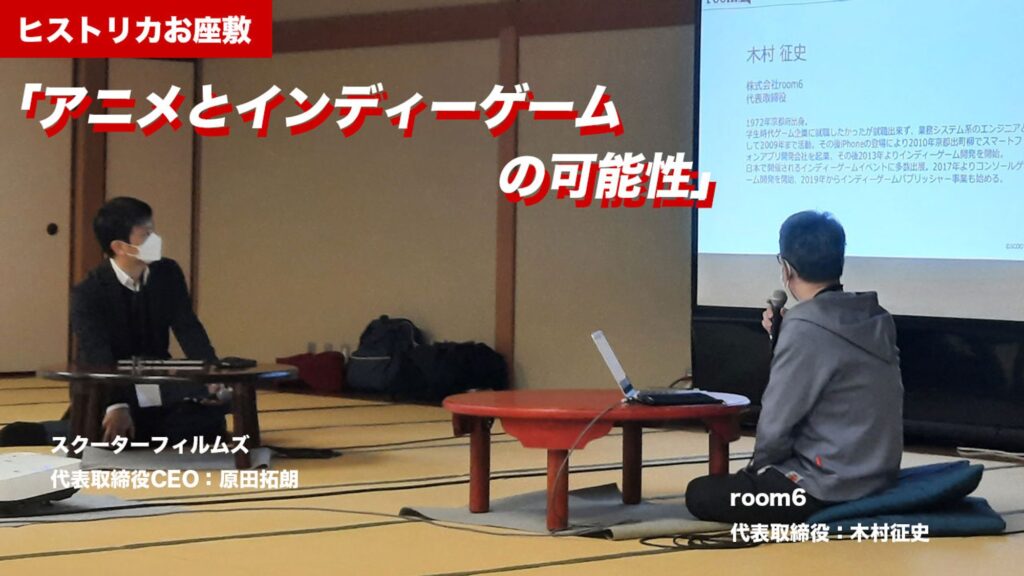
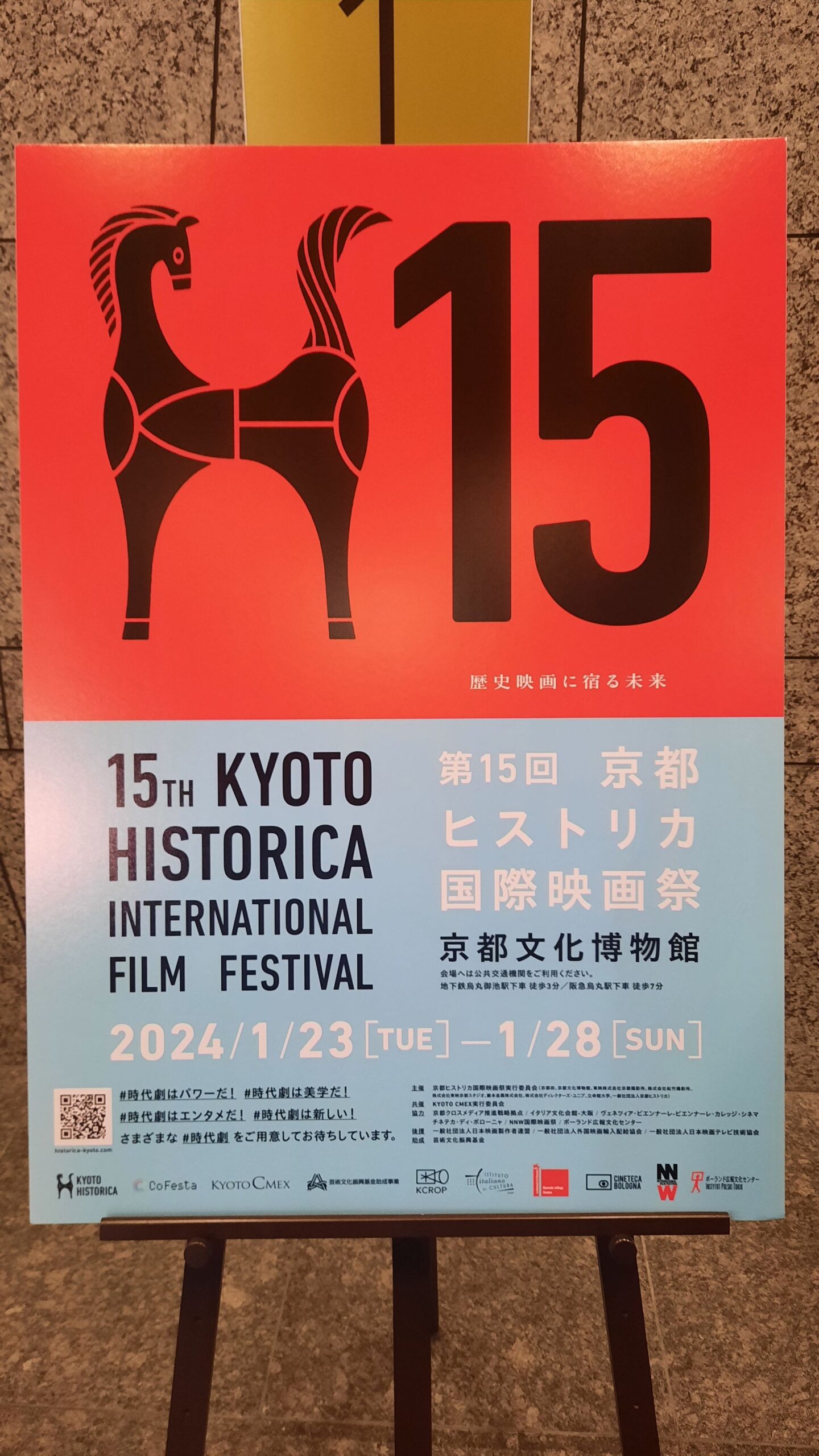
What is Historica Ozashiki: 15th Kyoto Historica International Film Festival
Moderator
We would like to start the first session of the Kyoto Historica International Film Festival and Historica Ozashiki.
With the title "The Potential of Anime and Indie Games," we have Mr. Kimura from room6 Inc. and Mr. Harada from Scooter Films Inc. joining us. Thank you very much.
Kimura
Now, let’s get started. First, I would like to begin with the self-introductions of the speakers.
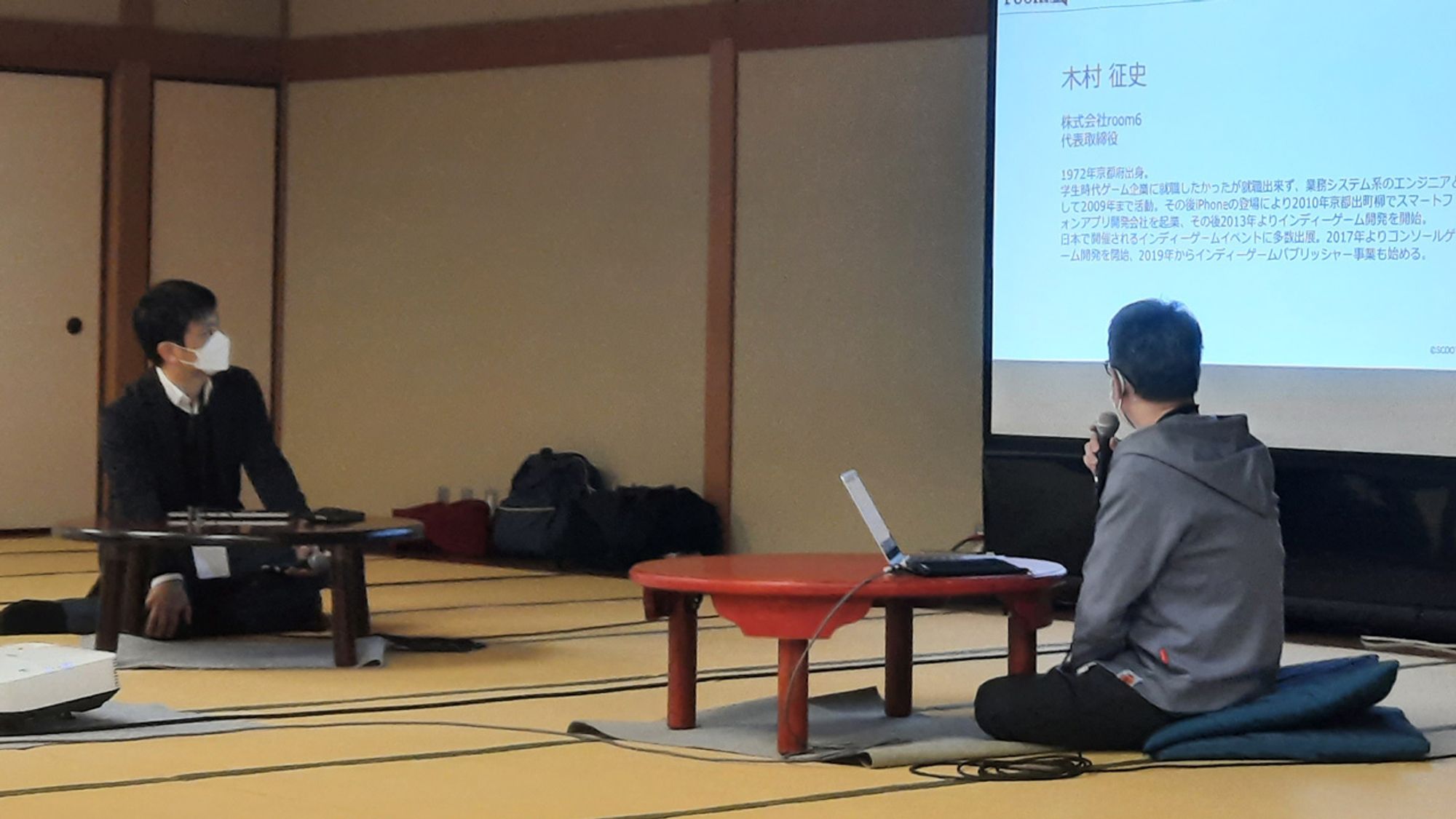
My name is Kimura. I am the representative of room6 Inc. I was born in 1972 and am from Kyoto, my hometown. I wanted to work for a game company during my student days, but that didn’t happen, and I ended up working in a completely different industry, as an engineer in business systems, particularly in finance, until 2009. After that, with the advent of the iPhone, I started a company in Demachiyanagi (Kyoto) to create iPhone apps. Then, around 2013, I began developing mobile indie games, and I have been involved in game development for about 10 years since then. Alongside that, I have participated in many indie game events held in Japan and started developing console games for the Nintendo Switch from 2017. I have also started a publishing business for indie games.
Harada
My name is Harada, the representative of Scooter Films. I was invited by Mr. Kimura to participate in this event. I was born in 1976 in Hyogo Prefecture and spent about 10 years in Kyoto during my student days. Like many others, I was deeply immersed in independent films and theater. Towards the end of my student life, before platforms like YouTube emerged, I thought that drama series for streaming could be the next big thing, so I gathered actors from various theater companies in Kyoto to create a drama series. However, I couldn’t monetize it at all and eventually ran out of steam. After that, I moved to Tokyo and started working in production at an anime company. The company I joined was more focused on what to do with anime rather than just making it, so I gained various experiences, including in surrounding businesses and licensing. Later, I was involved in the establishment of an anime planning company, and in 2021, I founded Scooter Films as one of the group studios of Twin Engine, which brings us to the present.
Kimura
Yes. Now, let’s move on to introduce the businesses of both parties and what they are doing. First, I will introduce our company, room6.
room6 Inc. is based in Demachiyanagi (Kyoto) and has been developing and publishing indie games since 2013, as mentioned earlier. A notable feature is that most of our team comes from non-gaming industries. While there are a few people from the gaming industry, about 80% to 90% of our team members do not come from game companies. We primarily develop games with beautiful graphics using pixel art.
Since 2019, we have also started publishing, and in 2020, we created an indie game label called Yokaze, and we have begun activities under that label.
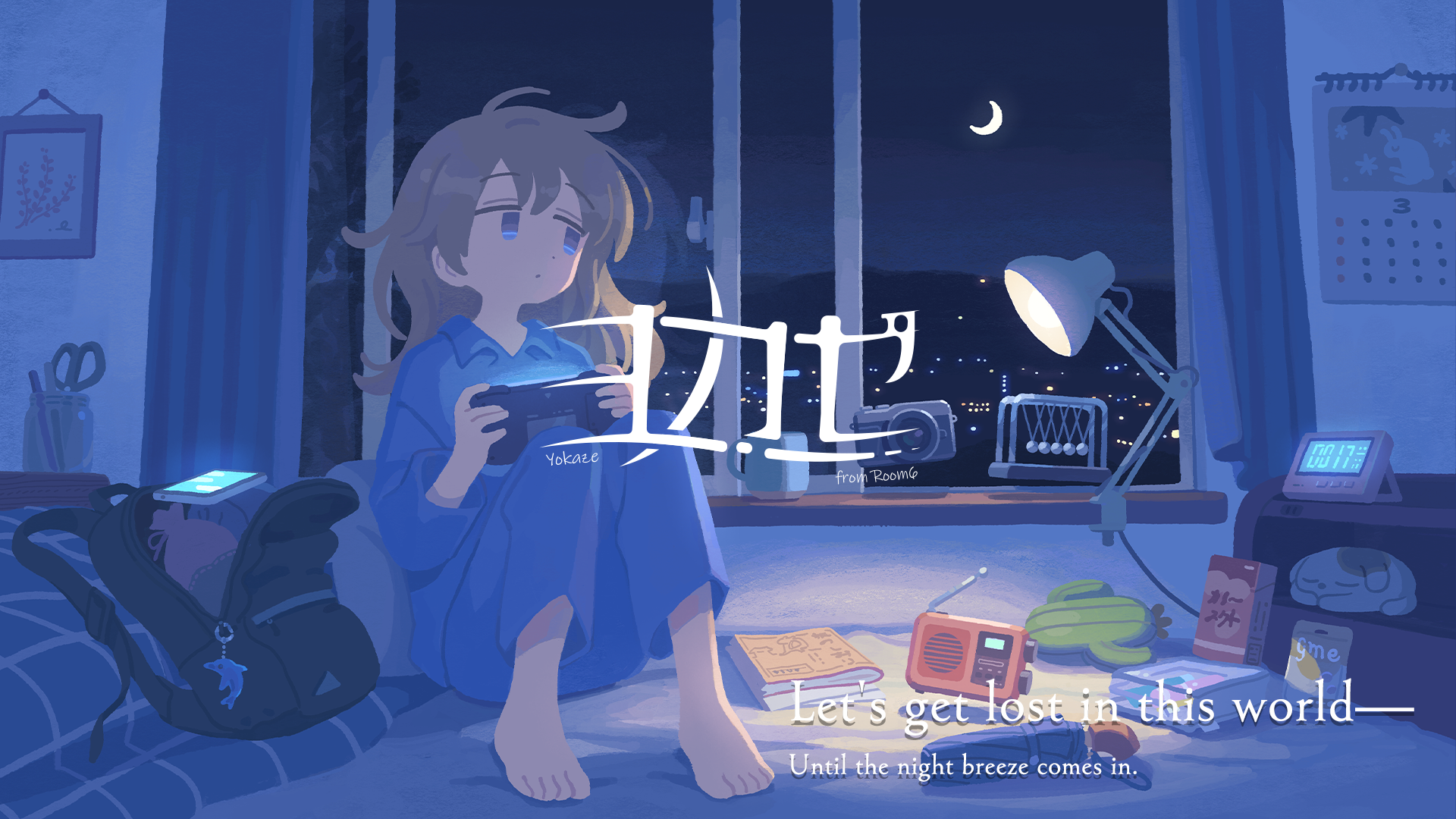
Let me give you a brief overview of this label. It's a somewhat abstract concept, but we focus on what you might call an emotional gaming experience, emphasizing story and world-building. Rather than game mechanics, we curate and release games that truly prioritize their atmosphere and artistic qualities. As you can see in this image, the name is Yokaze, and we tend to have many games with a moist, dark graphic touch, creating a vibe that feels distinctly "Yokaze." With that in mind, we are carefully selecting titles that immerse players in their worlds for publishing.
Now, let me explain what kind of games room6 is creating and releasing.
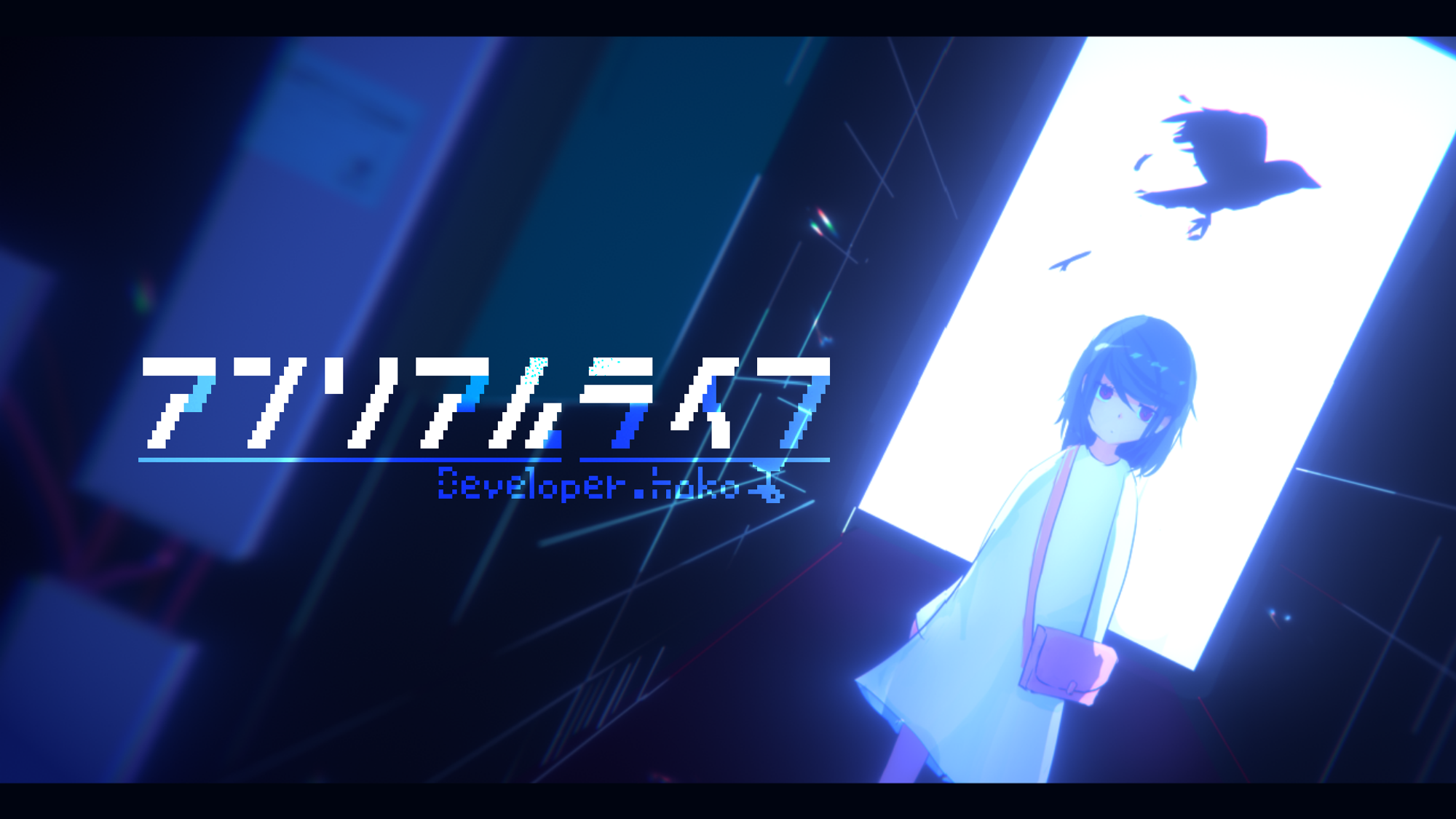
First, we have "Unreal Life", which is our flagship title released in 2020. It's an adventure game featuring a girl with the ability to read the memories of things she touches and a talking traffic light. This game was developed over four years by a single indie developer, who handled everything from the scenario to programming and music. It won the Newcomer Award in the Entertainment category at the 2021 Japan Media Arts Festival.
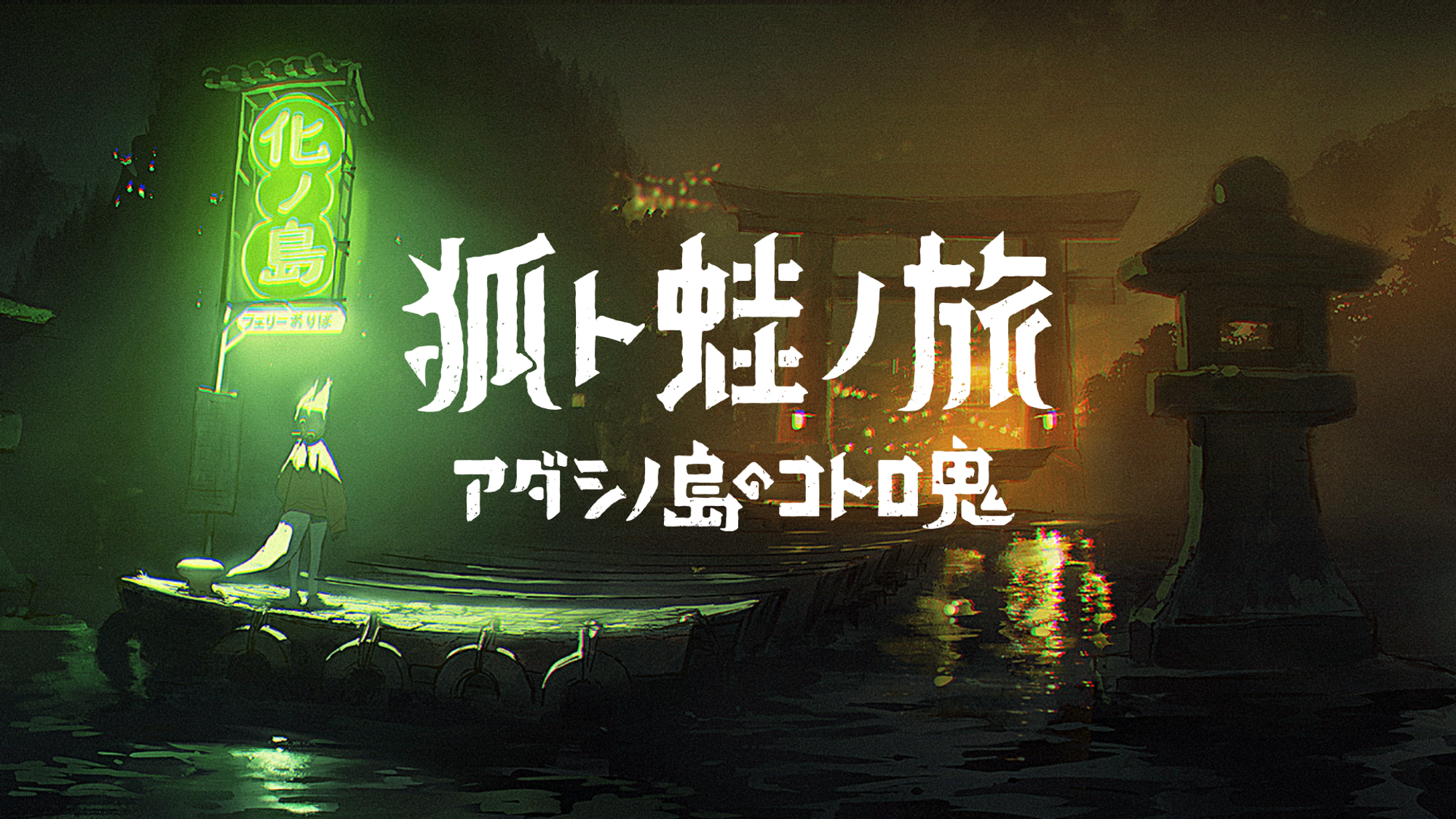
Additionally, we have an upcoming title called "Kitsune to Kaeru no Tabi: Adashino Shima no Kotoroni". This is a 3D action-adventure game set on a mysterious Japanese-style island. It's a rare 3D game for us. The developer, Rias, is a background and world artist, and although it's 3D, the art features a hand-drawn texture throughout. Everything is truly hand-drawn, utilizing hand-painted 3D textures, resulting in a beautifully emotional expression.
Harada
This art is amazing, isn't it? Just one piece draws you in so much.
Kimura
It really is great.
This is a highly anticipated work, and we hope to release it in the next year or the year after, but it's taking a lot of effort, so we ask for your patience.
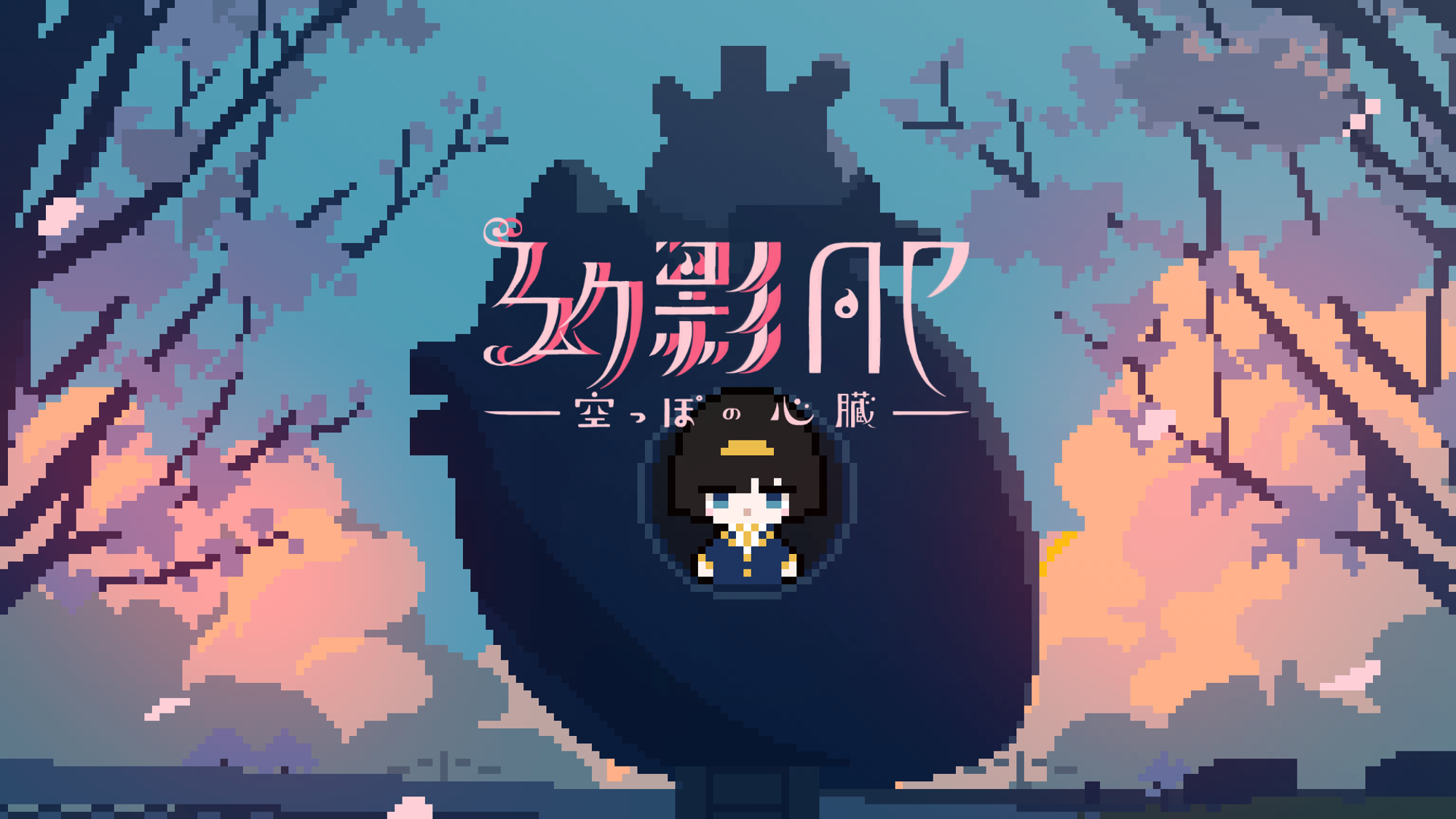
This is also one of our representative works, a pixel art piece titled “Phantom AP - Empty Heart.” This game is based on the world of a musician named Harumaki Gohan, who is known for his Vocaloid music. It’s an adventure game where you can walk through his unique universe.
We collaborate with various artists to create games, including musicians and those involved in music. This game features a charming pixel art world where players progress by walking in a 2D environment. It’s available for free on mobile, so please feel free to download and play it later!
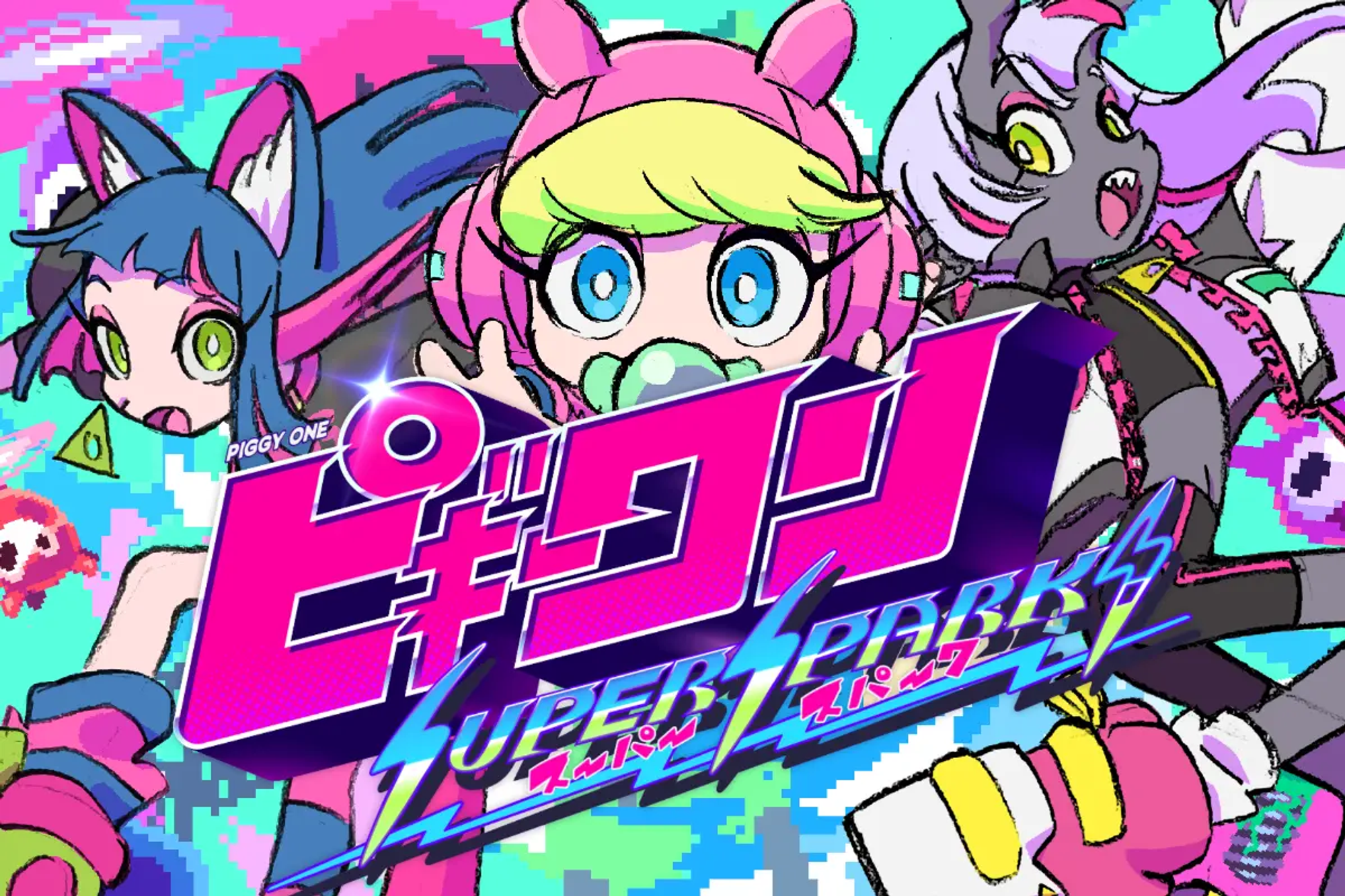
Next, we have a game currently in development called “Piggy One SUPER SPARK.” I’ll talk a bit more about it later, but it’s based on the IP of Piggy One, which has been illustrated by animator Hanabushi. This project aims to turn that world into a side-scrolling action game. Hanabushi is a well-known creator who has worked on music videos for popular musicians like “Zutto Mayonaka de Iinoni,” gaining significant fame.
Lastly, we have “Rogue with Dead,” which is a completely original project developed by our company, designed as an idle growth game for mobile. We released this in 2022, and last year it achieved 1 million downloads. It won a top 3 award at Google’s temporary game festival event, which is quite prestigious. At the end of the year, it also received the grand prize in the Best Indie Game category at Google Play Best of 2023, making it a highly acclaimed game.
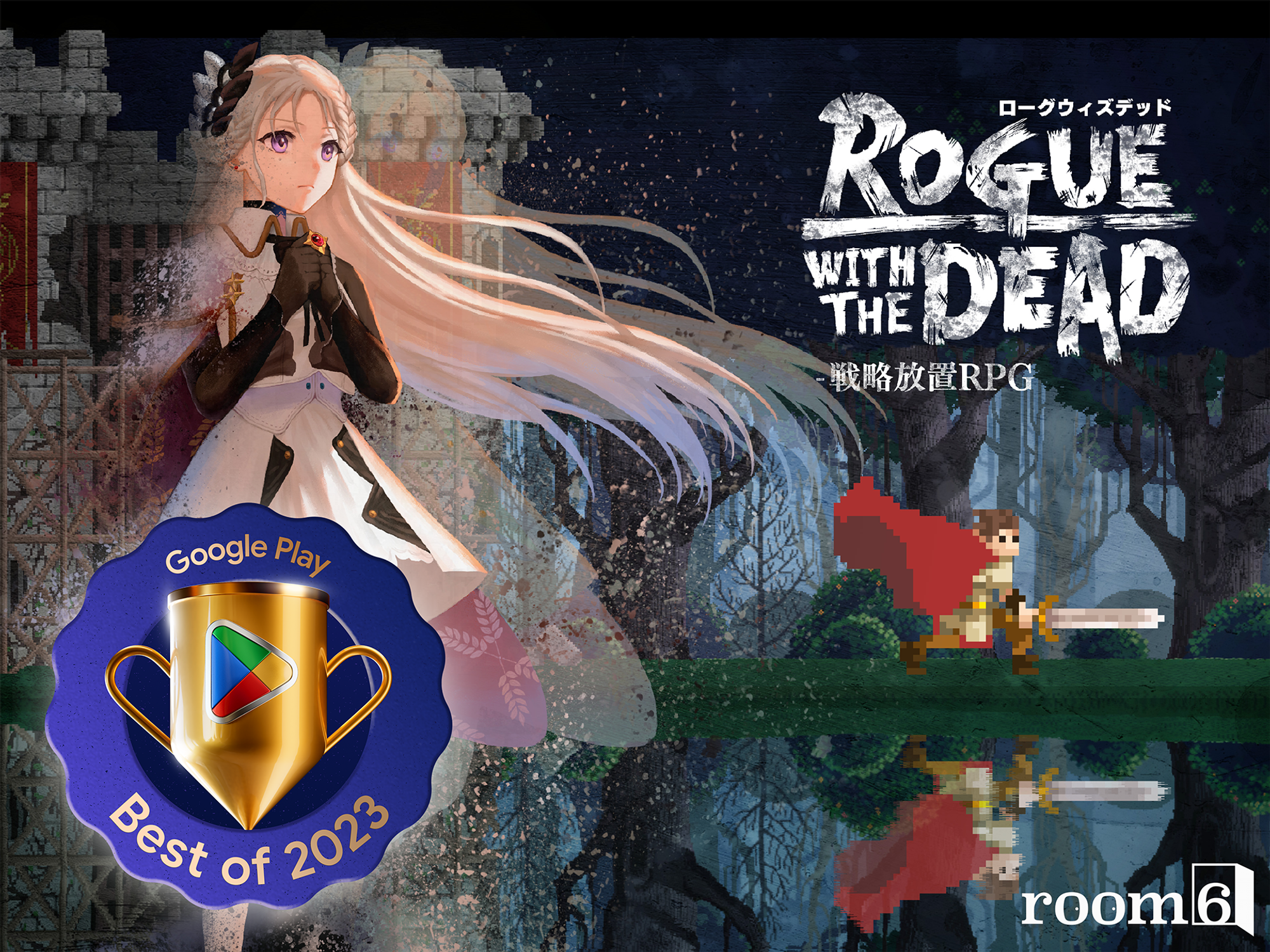
This is also pixel art, but I wonder if it’s okay to introduce it? The illustrator from our company who created this illustration is right here!
So, we are creating mobile games like this, and we have released various other games as well. Currently, we have 16 titles, but there are several other projects in progress, so we have about 20 projects either underway or already released. We may be a small company, but we’re surprisingly doing a lot!
What is an "Indie Game"?
In this context, I’d like to briefly explain what indie games are. The definition can be a bit vague, and discussing it can lead to disagreements, as people have different interpretations of what indie games are. However, broadly speaking, indie games are those developed by individuals or small teams, rather than large game companies. Generally, there’s a consensus that these games are not focused on sales or marketing, but rather on the motivation of wanting to create something or express an idea.
Indie game development often operates outside the constraints of corporate finances, accounting, and marketing, which means they can take risks that larger companies might avoid. This high-risk approach often leads to innovative and artistically rich games, which is why indie games have been gaining popularity for being more interesting lately.
Famous examples include “Undertale,” which became immensely popular worldwide, and games like “Cuphead,” which resembles Pixar or Disney animations, and “Minecraft,” which was originally an indie game created by a single person.
Harada
It doesn’t feel like Minecraft is an indie game, does it?
Kimura
That’s true. It has become the best-selling game in the world. However, it started as a game made by one person, so in a broad sense, it can be considered an indie game.
Additionally, there are survival crafting games like “Valheim” set in a Nordic backdrop, or “Stardew Valley”, or “Papers, Please”, or “Baba Is You”. From Japan, “Sakuna: Of Rice and Ruin” has become a million-hit success.
Harada
Is “Sakuna: Of Rice and Ruin” also an indie game?
Kimura
Yes, “Sakuna: Of Rice and Ruin” is indeed an indie game. It was created by a team that originally made doujin games, and they spent a very long time developing it. Although it is published by a major company called Marvelous, the development is primarily done by a team that operates like an indie game studio, so I think it qualifies as an indie game.
Harada
When it was first released, there were articles about it being an agricultural game.
Kimura Yes, I remember seeing a lot of articles about it. I don’t think there has ever been a role-playing game about growing rice before, but I think that’s one of the interesting aspects of indie games. So, I’ll pass the baton to Harada-san here.
Harada
Okay, let me start with a brief introduction about our company, Scoota Films. The company was just established in 2021, and you may or may not know, but there is a relatively large studio group called Twin Engine. If you check Twin Engine's website, you’ll see works like “Mononoke” prominently featured as movie titles for this summer’s roadshow. We are one of many studios, including Corolido and Geno Studio. Since we are a newly established company, our activity period is still short, so I’d like to share a bit about what I have done until now.
During my self-introduction, I mentioned that I joined a company called DLE in 2006, where I was involved in producing character animation. You might not be familiar with DLE, but if I mention keywords like “The Daisuke Taka no Tsume Secret Society,” some of you might recognize it. At TOHO Cinemas, it used to be featured in the intermission as a manner movie, and I worked on character animation there. I also frequently collaborated with teams in China to create anime, and I worked on original projects, including making a Chinese version of the Shimajiro movie.
Since moving to Scoota Films, I have been working on spin-off mini-anime series for famous game titles. “Umayuru” is distributed on our YouTube channel, where we create animations featuring the characters from Uma Musume as mini characters. While doing this, we have been considering how to develop original projects as an animation company since our establishment. We’ve been thinking about what elements are essential for creating original projects. First and foremost, we need to be able to create anime. This may sound obvious, but my previous company was focused on “planning,” so while there were main creators, they didn’t have a production studio. This made it difficult to bring projects to life. Therefore, we realized that we absolutely need a studio to take responsibility for the entire production process.
On the other hand, the core creators are incredibly important, and I strongly believe that we shouldn’t be too particular about whether they are internal or external creators. If we only focus on internal creation, it can become quite challenging, so meeting various creators is crucial.
Kimura
We have a similar approach. There are companies in the gaming industry that only focus on planning, and in that sense, we are aligned in our direction of embracing creators.
Harada
That’s right. From what I hear, you can create internally and also bring in external creators, so it seems quite close.
Kimura
Yes, it is.
Harada
Another point, especially in animation, is where to distribute it. There aren’t many places to sell animated content, and it’s crucial to connect with platforms where production teams can continue creating. Historically, there have been times when DVDs were the mainstay, and now we have streaming services and, of course, movies. It’s important to be connected to or integrated with strong media that can sell well and deliver to customers. Recently, there’s been talk about how to make a hit movie with TOHO, and when a movie hits with TOHO, good projects tend to gather there. Having strong media is definitely an advantage. In that context, our parent company, Twin Engine, was founded by Yamamoto-san, who established the famous late-night anime block Noitamina at Fuji TV. At that time, Noitamina was a very powerful platform, and many anime projects were born from it. I believe that having a “strong place = media” is very important. However, achieving this in a small company is quite challenging, so we are pondering how to approach it.
The third point, which is somewhat related, is that simply having strong media isn’t enough; it’s also important to know how to operate it and the power of branding. It’s not just about having something that sells if you leave it alone; the skill in this area can vary significantly. If you create a work and then leave it to others, the project won’t develop. We need to think seriously about how to deliver it to customers, create popularity, and cultivate fans. While the term branding might sound a bit vague, it’s essential for creators to consider these aspects seriously. We were thinking about how to form a team to tackle these challenges when we were starting out.
Kimura
That sounds great.
Harada
However, our company currently has about ten people in the studio, so there are limitations to what we can do. Nevertheless, we are committed to doing what we can, starting with animation production in our studio division. As for media, this might sound a bit presumptuous, but we have established and are operating our own web media, which is somewhat like owned media. While our media power is still developing, it serves as a place to meet people like you, Kimura-san, and connect with other creators.
If our company becomes solely about “business,” it leads to a situation where relationships are limited to client-vendor interactions, which poses a problem. While the current projects may be good, it becomes difficult to brainstorm new ideas or discuss fun concepts. Therefore, we wanted to create a space where we could meet various people and think about new projects outside the context of client-vendor relationships, which is why we are operating this media. We are also developing projects there, working with both internal and external creators, and we are currently in the process of contracting and managing those we can work closely with.
Particularly, we established a game division at the end of last year and started the SKOOTA GAMES label to dive into this area more deeply.
Let's go back a bit to the creator management section, starting with "Minami Research Institute." This is a duo creator unit, known as the original MV type, and recently they were responsible for character design in the anime series 'Heaven's Great Demon World' last year. Currently, we are also developing an original game with this team.
JINO is a young creator who just graduated from university last year. He is one of the so-called #indie_anime creators and makes very interesting MVs. (Not only that) he is the type who thinks of stories and projects, so we are currently working together to create a WEBTOON and develop the original story.
toubou. is also a young creator, mainly focused on illustrations, working in both illustration and animation. This person has recently created a short film with their creative work, and this year they plan to expand the world of the film while submitting it to film festivals, considering expanding from illustrations and animations to games as well.
Shiohigari is someone who primarily develops one-panel comics on social media, and I think many people might know them. Currently, we are working together on a new WEBTOON and also creating a murder mystery project together. We are doing things that Shiohigari wouldn't do alone.
Regarding media, as I mentioned earlier, SKOOTA. Right now, we are promoting an article featuring Kimura-san at the top.
Kimura
Ah, thank you.
Harada
Basically, it's a podcast where we listen to various people's stories, and later we turn that into articles. We are considering placing game projects on such a site and eventually also hosting WEBTOONs there, making it a place for that.
WEBTOON originated when we were thinking about how to launch original projects when we started up Scoota Films. Since starting with anime is quite difficult, we thought it would be better to start with manga. At that time, WEBTOON was gaining a lot of attention, so we thought it would be good to launch projects in the WEBTOON format rather than traditional manga. As I mentioned earlier, we are creating an original WEBTOON with JINO, and one realization from this experience is that with manga, there is a sense of "let's just start the serialization," but with WEBTOON, if you want to publish it on a specialized WEBTOON media, they often require you to have several episodes ready from the start, almost as if you need to have it mostly completed. It feels somewhat similar to how streaming dramas can't be released unless all episodes are made. This means that when launching, you need to have several episodes prepared in advance, which can become quite burdensome.
In fact, we have been working on this behind the scenes for a year, yet we still haven't been able to publish it, which has led to this situation. I have high expectations for the content and believe we are creating something interesting, but it has taken over a year, and we are just now at a point where we might be able to publish it this year. However, I think this is one of the heavier projects within WEBTOON, and as we consider submitting to major media, it tends to lead to that kind of situation. We are also thinking about whether to publish it ourselves, preparing to release WEBTOONs within SKOOTA.
So, that's the kind of company we are, but why are we starting to talk about "indie games"? Before that, in general terms about the anime industry, many people often say that the anime industry is in a bubble, right? It's an unprecedented bubble, they say. The number of productions and production costs are both on the rise, and that is indeed true. There is a continuous state of too much demand for anime production and not enough production resources, which is also a fact. However, I think there is a part of this that resonates with people on a gut level: original works from anime studios, excluding some brand studios, generally seem to be struggling.
What I think is even more serious is that the major streaming services have realized that adaptations of strong manga source material yield better numbers than original works. In other words, there was a moment when major streaming services were heavily investing in Japanese anime and trying to push anime studio projects, but it didn't go well. Since the numbers weren't coming in, they inevitably started saying, "Next, please bring us a Jump adaptation." This creates a situation where original projects become even harder to get approved, which is a general sentiment.
As this trend of relying on manga adaptations strengthens, studios are increasingly competing for powerful source material. Being part of an anime studio group, I feel this acutely. Around the second week after a manga serialization starts, discussions about anime adaptations begin, and it becomes a competition. Manga creators want their work to be adapted by a reputable studio with name recognition, and they often have specific directors or teams in mind. This puts the original creators in a strong position, and studios are evaluated by publishers, becoming subjects of selection. Studios are then pressured to effectively adapt the source material into anime, which creates a strong growth bias in that direction, leading to a trend where studios specialize more in adapting existing works rather than developing original content. I believe this is a general trend. This has created an environment where original works are difficult to produce, leading to a trial-and-error process in each studio about how to create original projects.
So, when anime companies first think of something, as we did, it's manga. Starting with original anime is too heavy, so they think, "Let's create a manga," or "Let's create a WEBTOON." However, manga publishers have a lot of know-how, and even if you try to create manga with a studio-like approach, it doesn't compete. Manga publishers have media and create within that framework, so it's quite difficult to just barge in with a standalone manga. Additionally, developing WEBTOONs turned out to be unexpectedly heavy. I love manga, but the know-how for manga expression is not present on the anime side, so just being able to draw in anime doesn't necessarily become a competitive point. There are various factors, and while it's not entirely impossible, there are definitely hurdles. Amidst all this, we started thinking about whether there might be other good methods, and that's when we encountered indie games last year.
Kimura
Yes. So, while President Harada is exploring the connection between anime and indie games, when we met, we actually shared that we have been combining animation and indie games since about two years ago. Because of that, I thought it would be good to share our success stories as a preliminary step in our efforts, particularly regarding our animation x indie game initiatives at room6.
First, we have a game we are developing called "OU." This is based on the world of the artist Kuda Uo, and it has been turned into a game. The backgrounds and everything are hand-drawn. I wanted to create a game that emphasizes hand-drawn art and animation, so when we started this game, I expressed my desire to focus thoroughly on animation. I had a strong commitment to this, so we hired professional animators, and all the animations in this game are hand-drawn, using traditional animation techniques, where even a single walking animation might involve over 20 frames. Normally, in side-scrolling games, tools like Spine are used to animate freely with bones, which makes it easy to mass-produce similar animation scenes. However, for this project, we did it almost entirely without using that, creating all animations by hand. Half of this was my commitment, and of course, my love for animation, but it resulted in something that looks really good in terms of quality. We even hired animators as full-time employees to create animations for this game, which is a notable example.
The next example is the project "Piggy One SUPER SPARK," which I mentioned earlier. There is an animator named Hanabushi, who became friends with Hako Seikatsu, an individual game creator behind the previously introduced game "Unreal Life." This led to the idea of collaborating, and we produced it from the ground up at room6. We aimed to prototype, launch, and sell everything under room6, not just turning an animation IP into a game, but making the game the first commercial release of his IP, which has garnered quite a bit of attention.
Harada
That is a noteworthy project.
Kimura
That's right. We are also very much looking forward to it. Originally, Hanabushi-san is a very popular animator with a unique worldview, and he has even done crowdfunding. It's quite heartening to see the amount of support he has gathered. So far, the crowdfunding seems to be a great success, and now it's just a matter of creating the game, but that said, the process has its challenges. Collaborating between an animator and a game creator to make a game is surprisingly difficult, and we are facing some struggles.
Harada
Hanabushi-san is gaining attention in the anime sector as well, being a core creator in the indie anime movement that has been branding itself over the past year or two, right?
Kimura
That's right.
Harada
He has a solid background working at a major, long-established animation studio, where he learned animation thoroughly and gained experience before entering the indie scene. He stands out as a bit of a big brother figure compared to other younger creators, doesn't he?
Kimura
Well, yes. In terms of age, too.
Harada
We're also curious about what kind of moves Hanabushi-san will make.
Kimura
Definitely.
Harada
When we were paying attention, it was like, "Oh, a game!" When I first visited Kimura-san's company, I got to hear about Hanabushi-san's crowdfunding project. But the interaction between animators and game creators is indeed challenging.
Kimura
Yes. Animators love playing games, but of course, they have never made one. So, they don't understand the game systems or mechanics, and they don't know how it feels to play.
Harada
That's true.
Kimura
However, they have a strong vision of what they want to create, so figuring out how to translate that into a game is quite difficult. The languages we use are quite different, and the translation process turned out to be unexpectedly challenging. It's similar to how we take the vision of producers or directors and turn it into a game; it's the same concept, but it feels like a dialect difference. It takes some time to fit those together.
There is the anime industry, the game industry, indie games, and indie anime, which are actually quite integrated. While there aren't many creators making games with indie anime creators yet, I think there's potential to blend the cultures effectively in the future. If this goes well, I would like to pursue it further. The indie scene is a bit chaotic, but I feel like a glimmer of hope is starting to shine through, and that's how the past couple of years have been.
So, we are discussing embarking on new initiatives.
Harada
That's right. We're considering indie games as a place for project development. Initially, when we thought of games, we felt that development was quite heavy. The image of app games was strong. I had heard various tough stories about managing app games, even though I'm an outsider.
Kimura
That's true.
Harada
Even big titles struggle, and my first impression was that games are tough. However, as I listened to various discussions, I learned about Steam, where it seems you can sell games that are more like doujin games, created independently by individuals. I thought, "Oh? A world like that is emerging," and as I explored further, I found many interesting examples. Just around the time I was sensing that there might be something here, I met Kimura-san and was able to hear his thoughts, which I was really grateful for.
At Scoota Films, we are primarily envisioning graphic novel games.
We feel that fighting through game systems is a bit outside our scope. Instead, we started thinking about challenging ourselves with graphic novel games as a starting point for developing a worldview and story that could eventually be turned into manga or visual adaptations.
Now, we have opened a site in this format and are also publishing on Steam. We started last autumn, and just yesterday, we were able to launch the page for our third game. Development is still ongoing, but right now, we are focusing on creating the worldview and the main promotional video for the project.
Kimura
This is an amazing story. I've met many people who want to make games, but they were from other industries. However, you are the first person to set up three Steam pages without my help, and I was really surprised. I've never seen someone so agile. Just setting up a Steam page is actually quite challenging, but I didn't help at all.
Harada
That's right. But now, if you Google, you can find information. It really comes down to whether you are ready to commit. There are many people in the anime industry who want to do things like this, but often, they don't even submit a project proposal. However, only things that are acted upon can take shape.
Kimura
That's true.
Harada
When it comes to realizing these ideas, it becomes a matter of not being able to back down. Once something is out in the world, you have to follow through with it.
However, I found it interesting that in anime, there is a strong emphasis on completing and releasing a project. This makes it difficult to propose new projects. Culturally, this seems somewhat unavoidable. There is certainly a feeling that releasing a project seed for a visual work is not quite right.
On the other hand, at last year's Bit Summit, I observed that in the indie game scene, many people were actively announcing and promoting their games even though they weren't finished, stating when they expected to complete them. I wondered about that, but I also thought it was very valid because it allows you to explore what kind of fans are out there and what expectations they have or don't have. Gradually, fan expectations build up, and then the finished product is released. Even after completion, I think there will likely be changes and updates.
Kimura
Yes, yes, that's right.
Harada
I felt that the way of growing a work together with fans is culturally different from anime.
Kimura
That's right. This is a huge characteristic of indie games. Regular games, like regular anime, have a set release date, and only then can they announce the schedule and start promotions. Of course, for big titles, there might be some sneak peeks, but the culture of maturing popularity and reputation together is significant on Steam. Steam has a feature called the wishlist, which allows people who are looking forward to a game to register it as a favorite. The more wishlist registrations there are, the more advantageous the algorithm is when the game is released. So, there are even people who start marketing strategies to get on Steam and have their game added to wishlists about three years before release. That's the kind of world it is.
Harada
That's right. I thought this was really rare. When I came in from the outside, I felt it was the biggest feature. Historically, I have been involved in independent films and theater, doing various "indie whatever," but in film, you don't submit something that isn't finished to a film festival. In theater, of course, you perform completed works, so you don't present something that's still in progress. The same goes for manga. Whether commercial or doujin, what is released is considered complete. Of course, there are those who share drafts, but fundamentally, they are released as finished products. So, I think the culture of indie games has very distinct characteristics.
Kimura
Sometimes, you can even win awards for something that isn't finished.
Harada
That's a mystery.
Kimura
First, you gather awards while still in production.
Harada
I think it's amazing. I feel like there isn't a happier platform for nurturing a work than this.
Kimura
It's interesting for creators, but it can also be quite challenging. It takes a lot of time to get things out, which can delay the creation process, but I feel like this is part of the indie experience.
Harada
So, we are looking to engage with that culture and follow suit.
While doing such things, there are still many project seeds that haven't reached that point yet. Earlier, I talked about the creators I'm managing, and right now, we are preparing a relatively large-scale game with Minami Research Institute.
Initially, we considered making this into a movie with the same content. We also thought about proposing it as an original anime series for streaming. However, since it's a work that no one knows yet, distributors and streaming services won't accept it. Even if we were to create it, if we made a movie and it didn't attract an audience, we would end up seeing many projects die off. I really don't want to turn something created with so much effort into that kind of situation. So, I think it's best to create an environment that nurtures fans of the work's world, and if we can achieve that, then visual adaptations would be fantastic.
Kimura
That's right. I believe indie games are in a zone where original and new projects are required, so I think it's a perfect fit.
Harada
Regarding "The Girls of the Ripple," earlier I mentioned toubou, whose real name is Souma. I said it started from a short film, and we just completed a 17-minute piece that we are sending to various international film festivals. As we were creating it, this short film started to feel like a compilation of something. Each high school girl living in this town has a very expansive worldview, and I wanted to see more of that. So, while thinking about how to expand it, I thought it might be easier to present it in the format of a visual novel game. Rather than jumping straight into a feature film, I think it would be better to showcase more of toubou's wonderful illustrations and explore how to expand from there. So, we are progressing with it as a short film, but at the same time, we are also preparing to expand it into a game. I feel that this work is quite close to the worldview of the Yokaze label that Kimura-san is working on, and I hope we can collaborate in some way.
Now, these are projects we are developing in-house, and these three are the ones we have released on Steam. Since we can work flexibly in-house, we were able to reach this point in about three to four months with focused effort. We started from project inception, created the artwork, developed the storyline, made a promotional video, and set up the Steam page.
Kimura
That's great. The worldviews and visuals are really impressive. I believe this kind of work suits animation companies very well.
Harada
That's true. However, we are not exactly a trendy anime company; our creative team has also taken a more personal approach. Rather, we encourage ourselves to run with it. We need to face what we want to do. Working on original projects is also about confronting that, so I think it has been an opportunity to confirm what can come from us.
Some projects have taken a humorous approach, and we are creating them with the mindset of going as far as we can. For instance, there is a project by an animator who loves drawing thighs, and they are creating it because they want to draw cute girls' thighs to their heart's content.
There are many other projects, but this isn't about backing down. I participated as a guest at the last Bit Summit (Kyoto), and while that was a lot of fun, I felt that exhibiting at such events is overwhelmingly more meaningful than just attending as a guest. So, we will be participating in the TOKYO INDIE GAMES SUMMIT 2024 event happening in early March in Kichijoji (Tokyo).
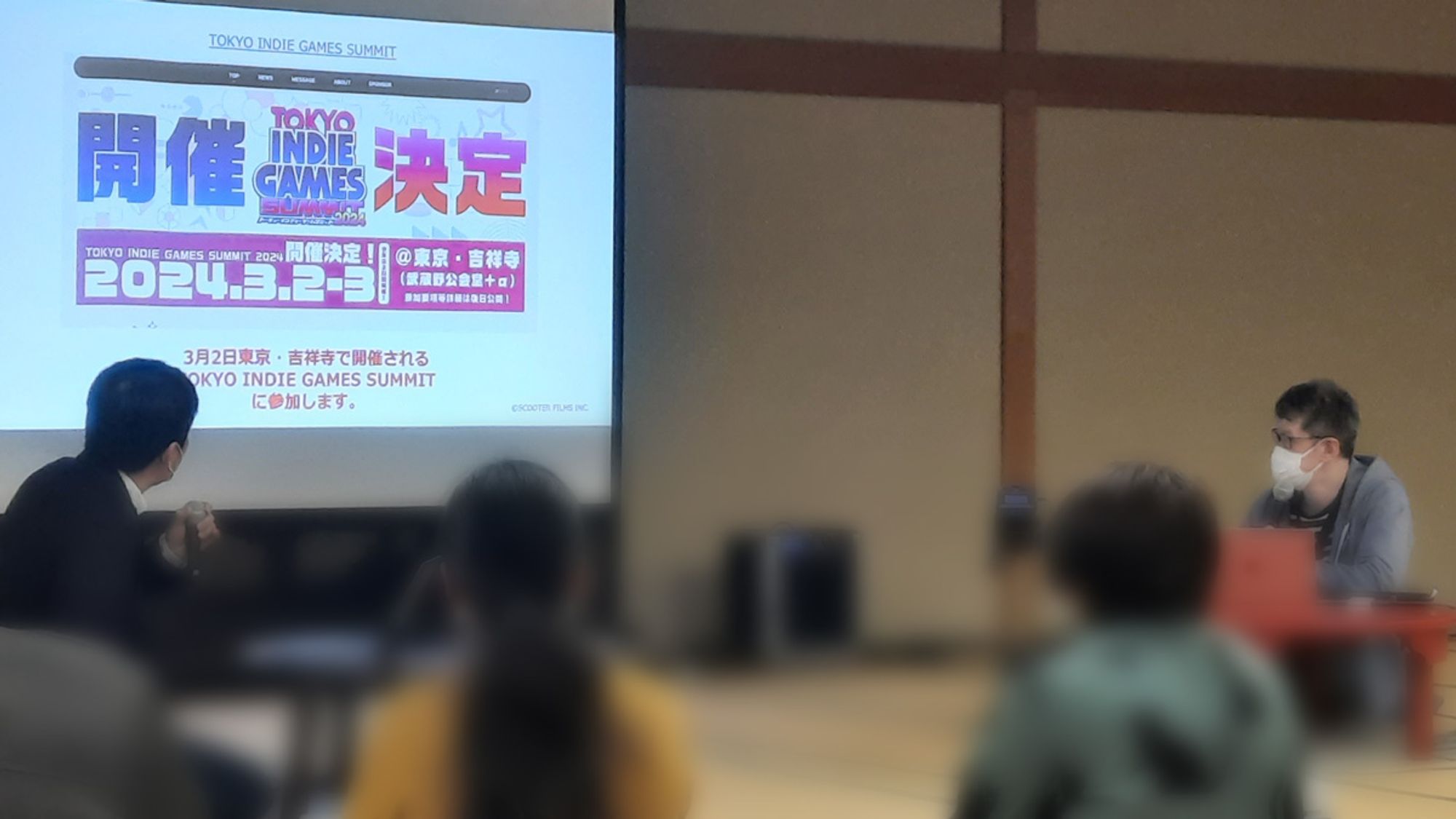
Kimura
Together, right next door.
Harada
That's right! Thank you for your support. I hope we can exhibit side by side and collaborate to push our projects forward! We also plan to participate in this year's Bit Summit.
Kimura
We will be there too, so we can be neighbors again.
Harada
Yes, I hope we can be neighbors again if possible.
Kimura
So, we are getting along quite well. We will share our experience in indie game promotion, sales, and production know-how, so let's create some great games together.
Harada
Absolutely! Kimura-san has said that, and it gives me a thousand times more courage. I believe we need to take action ourselves, listen to those who are doing it, and even collaborate to make it happen, otherwise, we won't progress.
Kimura
That's right. I've seen Harada-san's seriousness, and I can tell this is genuine. I have always thought that the fields of animation and indie games are highly compatible, and we've discussed various examples. I feel fortunate to have met Harada-san at just the right time. I love anime and manga, so this feels like a dream come true.
Harada
On my end, I've been in the video and animation field for so long that I feel I will be experiencing the challenges of game development quite a bit from now on.
Kimura
That's true. Games really don't get completed. Indie games take three times longer than expected. So, let's take our time and do our best.
Harada
Indeed. As you mentioned earlier, the Steam wishlist system is fantastic. Please log into Steam and search for "Scoota Films," and you will find the three titles we mentioned earlier.
Kimura
That's right. If you search for Room6's games, there are many that haven't been released yet, so please check them out and, if you can, register for them.
So, regarding "The Possibilities of Anime and Indie Games," I feel there is a lot of potential. I believe we can create some very exciting collaborations.
We've gone a bit over time, but thank you very much for today.
Harada
Thank you.
Moderator
Thank you, Kimura-san and Harada-san.