

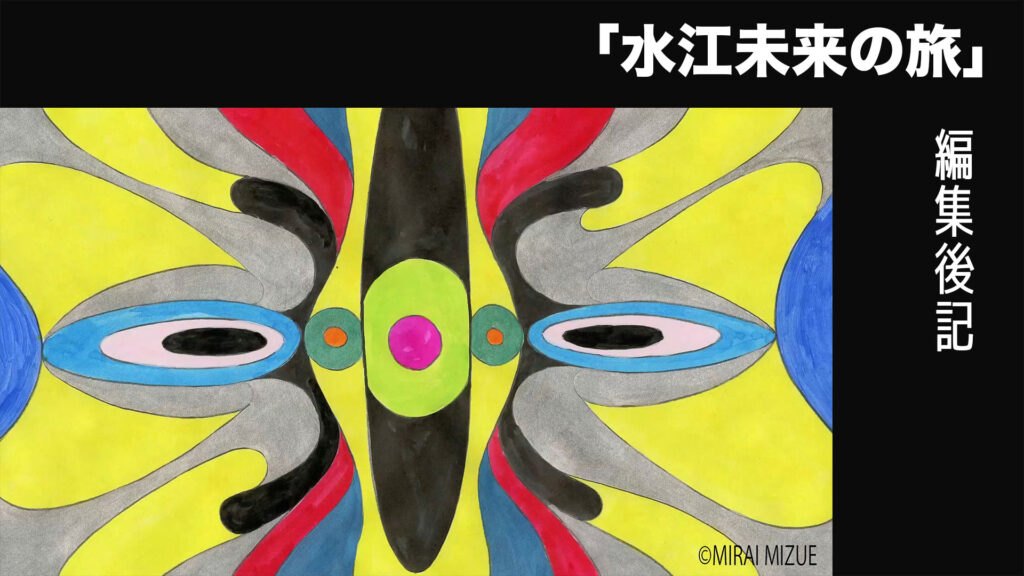
After the recording, it was reaffirmed that Mr. Mirai Mizue has established a unique position as an artist in Japanese animation, characterized by his "non-narrative" expressions that do not rely on storytelling. His works provide audiences with new experiences through the fusion of visuals and music, receiving high acclaim at film festivals both domestically and internationally. This article will focus on how Mr. Mizue established this unique style, exploring the background of his childhood film experiences and his approach to digital technology, as well as the deep meanings embedded in his works.
What is Non-Narrative Expression in Animation?
Miku Mizue's works are highly regarded at international film festivals as animations that pursue visual abstraction and experimentation. His style is often described with the term "non-narrative," but to truly understand its essence, one must explore his own words and the background of his creations. This article examines the meaning of non-narrative expression based on his interview, his childhood film experiences, his approach to contemporary animation, and his new animation work.
Firstly, the reason Mizue's works are considered "non-narrative" lies in their formal characteristics that do not center around a story. He does not completely eliminate narrative; rather, he captures narrative from different angles. For example, his works transform from concrete elements like cells and geometric shapes to abstraction, providing the audience with diverse interpretative possibilities. While this distinguishes them from traditional narrative forms, it offers a unique narrative experience.
Interestingly, Mizue's childhood film experiences significantly influence his current style. He experienced Hollywood blockbusters like "Jurassic Park" and "Terminator 2" in theaters during his youth. These films symbolize the evolution of CG technology at the time and left a lasting impression on him as a unique experience where reality and fiction intersect. Particularly, the liquid metal representation of the T-1000 in "Terminator 2" had a profound impact on him, becoming one of the motivations for pursuing the "alien" and "strange" in his later works.
Moreover, Mizue's approach to digital technology in his works is noteworthy. He is not an analog purist; instead, he actively incorporates digital technology to pursue "strangeness" and "otherness" in visual expression. The reason he uses these tools is to provide the audience with intense visual experiences, rooted in the "wonder of images" he cultivated in his childhood.
On the other hand, Mizue continues to hold a longing for the analog experience of theaters. In his feature animation "ETERNITY," he aims to draw the audience into a "ride-type" visual experience within a 20-minute runtime. This reflects his attitude of perceiving the experience of watching a film in a theater as part of the story itself. As he describes, the sensation of realizing "I was in the theater" the moment the film ends symbolizes the fusion of immersion and reality that films possess.
Overall, Mizue's works provide experiences that transcend narrative within a non-narrative form. The memories of films he experienced in childhood and his adaptation to modern digital technology are deeply intertwined in this background. His works will continue to offer audiences visual surprises and a sense of otherness. This is the greatest charm of his animation, and its evolution is highly anticipated.
About "Mizue's Journey (Tentative)"
To reiterate, Miku Mizue is an artist who stands out uniquely in Japanese animation. His works distinguish themselves from typical narrative-driven animations, pursuing non-narrative (non-story) and non-verbal expressions. Through these elements, he creates works that provide sensory experiences through the fusion of visuals and music, deeply resonating with the audience's inner selves.
One of Mizue's representative works, "WONDER," premiered at the Berlin International Film Festival and won the "CANAL+ Creative Aid Award" at the Annecy International Animation Film Festival. This work is a 6-minute animation that brings joy through visually transforming colors and forms, combined with music by PASCALS. An episode is recounted where a woman from Berlin expressed, "From tomorrow, I will wear colorful clothes and try to incorporate WONDER into my life." This moment was when Mizue recognized the power of non-narrative, non-verbal expression, significantly influencing his subsequent production approach.
Words can sometimes lead to misunderstandings. Even when sharing the same language, meanings can differ based on generation and experience. Mizue may feel the ambiguity of communication through language, which further highlights the value of non-verbal expression. For instance, just as "WONDER" can prompt spontaneous thoughts and actions in the audience through visual and musical experiences, non-verbal expression possesses the power to make the audience "think from within themselves."
Such works by Mizue not only provide visual stimulation but also have the power to bring about changes in the audience's inner world. Non-narrative, non-verbal expressions offer room for the audience to interpret freely and engage their sensitivity without narrowing the scope of interpretation. Therefore, abstract expressions that do not rely on words can potentially trigger inner transformations in the audience.
Furthermore, Mizue's current project, the feature animation "Mizue's Journey (Tentative)," represents a different challenge from his previous short works. It is expected to reinterpret the classic story of "Journey to the West" in a sci-fi manner, incorporating multiple perspectives and multiverse elements. This project will likely explore unique answers that ultimately transcend Buddhist motifs and religious viewpoints. The story he depicts will delve into profound themes such as how humans should live and how they should perceive the world, with abstract animation techniques playing a significant role in his approach.
Mizue's works do not merely convey messages unilaterally to the audience; rather, they encourage the audience to confront their inner selves and promote free interpretation, eliciting deep empathy and emotion. The non-narrative and non-verbal approach directly appeals to the audience's sensitivity, enabling communication that transcends words.
I am very excited to see how his next challenge, "Mizue's Journey (Tentative)," will provide the audience with new perspectives and experiences, and how his unique expression will evolve. The power of his works will continue to influence many audiences in the future.
Animation is Starting to Cross Boundaries, Chaotic but Stimulating
Mizue's works may initially appear to consist of difficult and abstract visuals, but deep themes are hidden within. The theme of "life and death" in his works is particularly intriguing. In an interview, he expressed a "sense of life and death expanding and complicating," which is greatly influenced by his life experiences and the scientific magazines he encountered in childhood. He perceives "nothingness" and "being" from a scientific perspective, holding the sense that simply being alive is a mysterious state. This feeling is often visually expressed in his works, strongly evoking the "ephemerality of life" and the "mystery of existence" in viewers.
The aforementioned feature-length animation "Journey to the West (tentative title)" is a work that can be described as a culmination of expression. This work is expected to feature many characters, each with their own unique personalities and backgrounds. As seen in the music videos he has produced, his character designs are highly distinctive and captivating. He mentions being influenced by "Star Wars" and "The NeverEnding Story," suggesting that his work will include many characters, each playing an important role in the narrative.
Moreover, Mr. Mizue feels that the entire animation industry has entered a "chaotic era." As the boundaries between commercial studios and independent creators become increasingly blurred, and new methods of expression and technology emerge one after another, he continues to create works while enjoying this change. In this context, Mr. Mizue is actively pursuing new challenges to expand the possibilities of animation as a form of expression.
As expectations grow for Mr. Mizue's future works, I also want to observe how his animations will continue to express themes of "life and death" and "the mystery of existence." His works carry deep messages that go beyond mere entertainment, and it will be very interesting to see how these messages are conveyed in the future.
(Written by: Yuki Sakoda)